Literary Birthday: Lillian Hellman

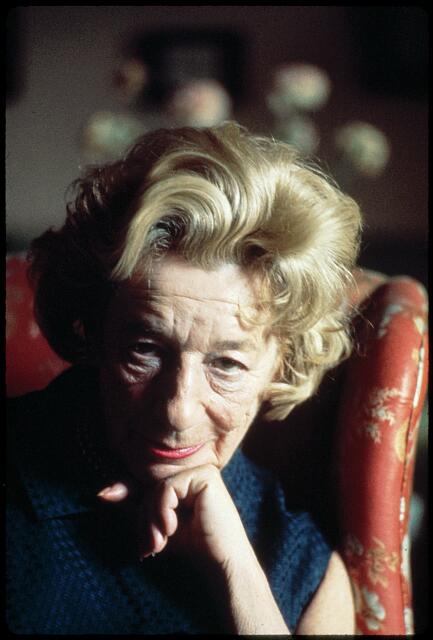
Lillian Hellman (born today in 1905) was raised comfortably in Louisiana before her family, who did not always manage their money well, moved to New York. There, she worked various jobs while trying to get her writing career off the ground. When it did, with the 1934 premiere of her hit play The Children’s Hour, her success came with a heavy helping of controversy. Based on an incident that took place in Scotland in 1810, the story was set at an all-girl’s school where a student spreads a lie that the two women running the institution were lovers.

A milder version of the moral panic Hellman depicted greeted the play itself, which was considered too dirty-minded for the Pulitzer Prize. She, along with her longtime paramour Dashiell Hammett, palled around with Communists and other radicals. This gained her the attention of J. Edgar Hoover, who put the playwright under surveillance. Hellman’s FBI file runs to over a hundred not terribly interesting pages: “Miss HELLMAN did not engage in any Communist activities in Fairbanks.”

Writer’s Desk: Lie to Tell the Truth

The passing of the great Janet Malcolm this week at the age of eighty-six is not a thing that the world of writing will bounce back from. One of the great profile writers the New Yorker ever had, Malcolm had a spare and wry yet richly illustrative style that compressed whole volumes of insight into a few lines.

But the work that everyone will continue going back to is The Journalist and the Murderer (1990), ostensibly the story of how the relationship between writer Joe McGuiness and murder suspect Jeffrey R. MacDonald unraveled in spectacular fashion, but really an X-ray of why and how journalists do what they do.

In this slim and cutting book, Malcolm characterizes her profession as a confidence game of sorts:

Fortunately for readers and writers alike, human nature guarantees that willing subjects will never be in short supply. Like the young Aztec men and women selected for sacrifice, who lived in delightful ease and luxury until the appointed day when their hearts were to be carved from their chests, journalistic subjects know all too well what awaits them when the days of wine and roses — the days of the interviews — are over. And still they say yes when a journalist calls, and still they are astonished when they see the flash of the knife…

Malcolm knows that for a writer to tell the truth about something or someone, they must often first strew the path before them with lies.

Literary Birthday: Chris Van Allsburg

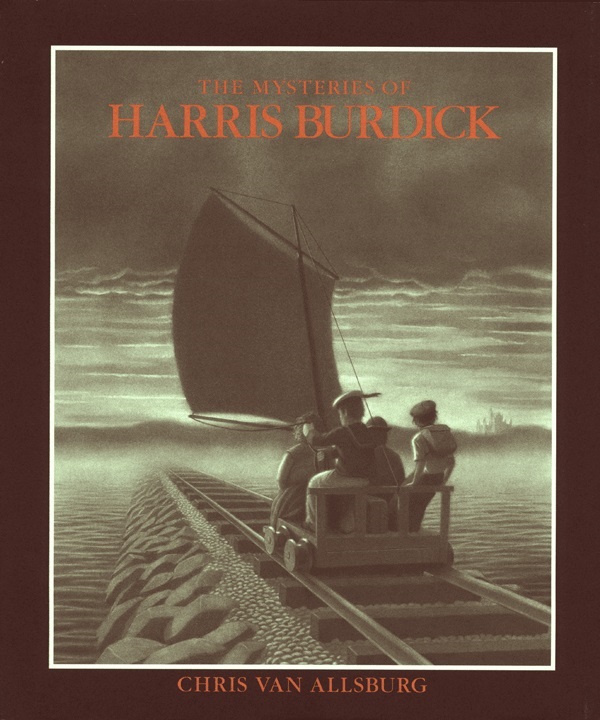
Caldecott-winning author Chris Van Allsburg (born today in 1949) began his creative career studying and making sculpture. Some of his pieces from the 1970s have a puckish, off-key humor that would later be familiar to his readers (1974’s Event at the Observatory shows a B-movie flying saucer crashed into an observatory dome). He only took up writing and drawing children’s books later.

His first book, The Garden of Abdul Gasazi (1979), in which a boy stumbles into a fantastical garden with surreal and somewhat threatening topiary, established the signature grey-toned look he would use in later books like Jumanji (1982) and The Polar Express (1986). But it was less a conscious choice than a practical one, as Van Allsburg’s schooling had only really acquainted him with using pencil and charcoal pencil.

Writer’s Desk: Read Raymond Carver

That’s what Rachel Cusk noted when she was asked to list her six favorite books. She included the collected stories of Raymond Carver, once the demigod of American creative writing for his oft-imitated clean, spare, scalpel-like style (sure, it may have been the work of editor Gordon Lish, but who’s keeping track?) because he can always teach us something:

His writing remains the best modern example of the technical and disciplinary basis of literary art. I often go back to Carver to remind myself what the rules are.

What are those rules? If you do not need it, leave it out. Find the emotion but don’t describe the emotion. Make everything high stakes while seeming to be low stakes. For starters.

If you are looking for a way to procrastinate on your writing some more, here are Cusk’s other favorite five:

  • The Rainbow by D.H. Lawrence
  • The Magic Mountain by Thomas Mann
  • The Collected Stories of Katherine Anne Porter
  • The Plague by Albert Camus

TV Room: ‘Monty Python: A Celebration’

There is a nifty four-part show on PBS right now called Monty Python: A Celebration. It’s essentially a plus-sized clip show of fantastic Python bits intermixed with various comics like David Cross and Patton Oswalt reminding us why that troupe of fish-slappers and parrot-killers helped set the stage for almost everything interesting in modern comedy.

For some reason, they also asked me to hold forth on the same.

You can find it streaming here. Otherwise, as they say, you can check your local listings.

Lest you forget, Monty Python FAQ, which I co-authored with the good messrs Cogan and Massey, can still be purchased wherever you get your books. Like here. Or here. Maybe here.

Literary Birthday: Louise Erdrich

After growing up in North Dakota, where her parents taught at a Bureau of Indian Affairs school, the part-Ojibwe and part-German Louise Erdrich (born today in 1954) became one of the first women admitted to Dartmouth College. Inspired to write by her parents—her father paid her a nickel a story—wrote numerous books (novels, poetry, nonfiction) that frequently explore Native American traditions and issues, first gaining critical acclaim with her novel Love Medicine (1984).

In 1999 she published The Birchbark House, the first in a series of young adult novels set in the Ojibwe community. Two years later, Erdrich opened Birchbark Books in her home city of Minneapolis. The store offers a wide selection of native artwork and features a wooden canoe hanging from the ceiling and an old church confessional that has been refashioned into a “Forgiveness Booth.”

Writer’s Desk: Start a Diary

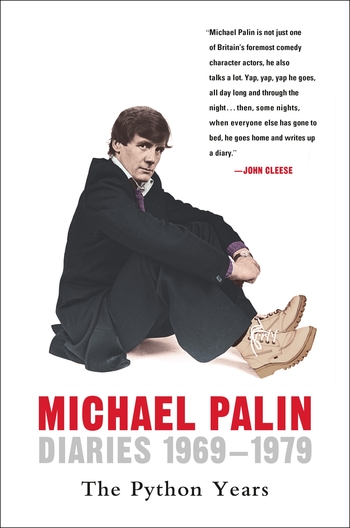
Michael Palin, of Monty Python and travel-writing fame, has been writing in his diary since 1969. Even when nothing much is happening. Palin is a special case, because he can look back and read about that time he was with David Frost or John Cleese or at some little café in Tangier.

Still, for a writer a diary can be something of a gold mine. This is especially the case if you have a gift for description and observation. Several years’ worth of tracking what is happening around you can come in handy when looking for material later on.

But one doesn’t want to slap just anything down. Even if it is just your diary. Palin has some handy don’ts:

  • “Don’t be too obscure. British upper-class diaries are prime examples of this fault, as in Sir Arthur Fforbes-Ffinch’s account of London life in the 1920s: “January 4th: Bo-Bo, Tiggy, Spaff, Flatto, Gin-Gin, Mobbles, and Goofy came round and we all drank Brown Monkeys and played Sham-Sham until we’d crocked Bonzie’s and had to rumble.” Completely inexplicable if you didn’t know it was a Cabinet meeting.”
  • “Don’t try and make your life interesting when it isn’t. Diaries must be brutally honest. If you had only one egg for breakfast, write “Had egg for breakfast.” Don’t feel you have to have had 12 eggs for breakfast just to get in the diary.”

Also, one very helpful to-do:

  • “Write every day. Diaries are all about habit. They should become a regular part of your day, like cleaning your teeth or going to the lavatory. And, if possible, just as interesting.”

Literary Birthday: Allen Ginsberg

(L-R) Lucien Carr, Jack Kerouac, Allen Ginsberg, William S. Burroughs

Allen Ginsberg (born today in 1926) entered American literary infamy on the night of October 7, 1955 at a gallery in San Francisco, when he read his iconic poem “Howl” for the first time. The stage and audience included many other writers who had not quite achieve boldface status (Jack Kerouac, Kenneth Rexroth, Gary Snyder). Ginsberg went on later in the evening, by which time the audience had been indulging for several hours (urged on by Kerouac, who described in The Dharma Bums telling everyone that “mad night” to “glug a slug from the jug”).

The reception to Ginsberg’s ecstatically exuberant Whitman-esque flight of prophetic fancy blew the doors off, with the crowd yelling (per Kerouac) “Go! Go! Go!” as though they were at some late-night bop session. City Lights publisher Lawrence Ferlinghetti was in the audience as well. He published the collection Howl later that year and was promptly arrested for indecency and obscenity.

Writer’s Desk: Write, Don’t Worry

In Ocean Vuong’s 2020 novel On Earth We’re Briefly Gorgeous, his background as a poet becomes clear in the shards of impressionistic scenery, the free-flowing memory, the jolts of fricative emotion.

He also, in one sweet line, asks a question that many writers might think they know the answer to:

What if art was not measured by quantity but ricochets?

Writers would say, Yes and amen to that. Because a good numbers of want the numbers, of course (whether it’s sales or fans or even compensation). But what sits down deep in many of us is the idea that what we do leaves us and bounces out there in the world, maybe connecting with somebody, and possibly even multiple somebodys.

But then Vuong lops off the last part of that line and circles back to ask a harder question:

What if art was not measured?

This is the healthier response of course. But also one that so many of us will find it impossible to follow by not measuring ourselves against all the other writers out there.

Try as we might.

Literary Birthday: Harlan Ellison

A motormouthed, frantically productive science-fiction writer who made a decent living in the pulps before finding his voice in the genre’s boundary-smashing New Wave period of the 1960s, Harlan Ellison (born today in 1934)—who preferred being called a “fantasist,” thank you very much—had almost as many as opinions as published works.

In college, he punched out a professor who critiqued his writing. To express his displeasure with a publisher, Ellison mailed them an odiferous gopher corpse. For others who incurred his irritation, he used a form letter that began: “Dear Sir (or Madam), Clearly some brain-damaged moron is writing letters and signing your name. I suggest you do something about this.” After Ellison’s death in 2018, George R. R. Martin described his late friend as a “temperamental, exhausting, raging, loving, roaring giant” who started so many feuds that his antagonists actually formed a club: Enemies of Ellison.

Writer’s Desk: Rules? What Rules?

So Seth Rogen has a book out. That may surprise some who just think, “The guy from Knocked Up?” He’s almost more writer / producer these days than charter member of the Judd Apatow comedy mafia.

Rogen and his longtime friend Evan Goldberg have something of a screenwriting machine going, ranging from instant classics like Superbad to series like Preacher to, well, The Green Hornet. So they know how to put words on the page and make something out of it.

Of the advice they gave to The Script Lab, one item in particular jumped out:

Any rule can be broken. They’re just basic guidelines that you can just shatter if the moment is right.

It seems obvious, but really it is not. We all have rules that get stuck in our head, from hanging that gun on the wall in the first act to the number of red herrings to give your detective hero before he/she finds the killer (by the way, that number has been scientifically calculated as 4.5).

But each and every one of them should be hurled out the window with great force the second they get between you and your story.

Screening Room: ‘The Dry’

My review of the perfectly okay new Eric Bana mystery The Dry is at Slant:

It would be difficult to find a worse candidate for solving the murder-suicide that lies at the heart of Robert Connolly’s The Dry than its hero, federal police officer Aaron Falk (Eric Bana). Not only is he prejudiced about the case because he was once close friends with Luke (Martin Dingle Wall), the initial suspect, but almost everyone in the small town where the killings took place despises Aaron for his connection to a 20-year-old scandal. In reality, this would create a near-impossible barrier for any investigator to overcome. But this is the kind of mystery where a standup cop willing to doggedly bang his head against enough walls can always knock the truth loose, even if he might be a murderer himself…

The trailer is here:

Literary Birthday: Nora Ephron

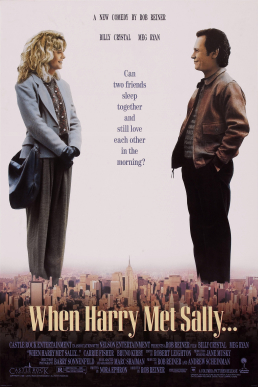
Like many writers, Nora Ephron (born today in 1941) started out as a journalist. She was a researcher at Newsweek and a cub reporter at a pre-Rupert Murdoch New York Post, where on her first day she was sent to the Coney Island Aquarium to write about a pair of seals who were supposed to mate but had so far refused to. Unlike many writers, she was married at one point to Carl Bernstein.

Her novel Heartburn (1983) was based in large part on Bernstein’s affair with another woman while Ephron was pregnant. In 2005, Ephron wrote that not only she had figured out on her own the identity of Bernstein and Woodward’s Watergate source “Deep Throat” (FBI associate director Mark Felt) years before he came clean about it, but that she had been telling people so for years: “Not for nothing is indiscretion my middle name.”

Writer’s Desk: Leave Some Room

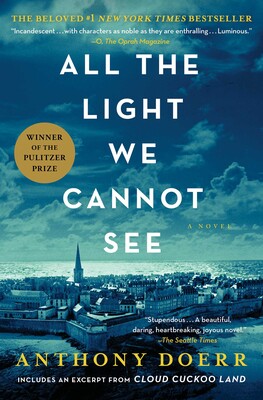
Anthony Doerr writes large books with an epic sweep. They feature dramatic action but also layered descriptions with particularly sparkling language. Per The Writer, Doerr knows this can be a lot for some readers. In a 530-page novel like All the Light We Cannot See, he keeps many of the chapters to just a page or two:

Because I’m a fairly lyrical and dense writer, I felt like it would be nice to give the reader these white spaces, these bursts of recovery time … Like a little bit of oxygen before diving back in again

Literary Birthday: Francine Pascal

Francine Pascal (born today in 1938) grew up showbiz-adjacent in Queens (her brother Michael Stewart wrote the book for Hello, Dolly!). But after a stint writing for soap operas, Pascal made her mark in a different format. In 1983, she had an idea for a teen soap opera about 16-year-old twin sisters (good Elizabeth and more risqué Jessica). An eager publisher snapped up the idea. Ghost writers were hired. Pascal was in charge of outlines, characters, inspiration, and continuity.

The first Sweet Valley High paperback was released that year. Their popularity smashed records and birthed a new subgenre (The Babysitter’s Club, et al). In 1985, Perfect Summer became the first New York Times-bestselling young adult title. By the time the series ended in 2003, it had published 152 titles and sold roughly 250 million copies. After all those stories, though, the sisters never managed to reach their seventeenth birthdays.