Writer’s Desk: Don’t Be a Jerk

The topic of cultural appropriation is never an easy one, particularly when it comes to writing. When Lionel Shriver, author of We Need to Talk About Kevin, launched her jeremiad at the Brisbane Writers Festival, she steadfastly stood on the side of writers being free to write about whatever and whomever they damn well pleased, regardless of their race or background.

It was the speech that launched a thousand op-eds. Many leaped to Shriver’s defense, seeing a long-overdue pushback against the forces of political correctness, trigger warnings, and so on. Others saw it as just another example of white cultural dominance and arrogance.

sympathizer1There was more than a little of the provocateur in what Shriver did, of course—wearing a sombrero to make some point, and blasting any critique of her work from cultural grounds as censorship.

Into this white-hot mess waded Viet Thanh Nguyen, author of the excellent novel The Sympathizers. In an essay for the Los Angeles Times, he valiantly carves a demilitarized zone out of the culture-war battlefield:

…engage in careful and curious conversation with people different from ourselves, both in terms of demographics and ideas. When I say careful, I mean that it is possible to use one’s free speech and yet also be respectful and ethical. It is advisable not to insult people, as in the case of a white author wearing a sombrero to make her point about cultural oversensitivity. When I say curious, I mean that too many of us are not interested in the lives of others, if my experience with my airplane seatmates is any indication.

Solid advice for any writer, under any circumstances.
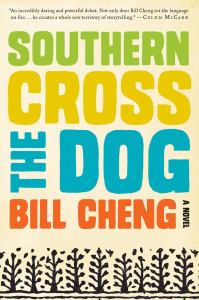
southerncrossAlso, note novelist Kaitlyn Greenridge’s response to the Shriver dustup, in which she considers whether Asian writer Bill Cheng had the right to write a lynching scene:

…I felt so strongly that Bill had a right to write that scene because he wrote it well. Because he was a good writer, a thoughtful writer, and that scene had a reason to exist besides morbid curiosity or a petulant delight in shrugging on and off another’s pain — the fact that a reader couldn’t see that shook my core about what fiction could and couldn’t do.

So, a few things to consider when writing about events, places, or people outside your immediate experience; or even well within it:

  • Be careful
  • Do the work
  • Do it well
  • Don’t be a jerk

Writer’s Desk: Wodehouse Kept It Simple

wodehouseP.G. Wodehouse (1881–1975) didn’t live to such a ripe age by worrying about things, like directions or keeping cash about the place.

In this 1975 interview from the Paris Review, he lays out a brisk but simple writing schedule:

I still start the day off at seven-thirty. I do my daily dozen exercises, have breakfast, and then go into my study. When I am between books, as I am now, I sit in an armchair and think and make notes. Before I start a book I’ve usually got four hundred pages of notes. Most of them are almost incoherent. But there’s always a moment when you feel you’ve got a novel started. You can more or less see how it’s going to work out. After that it’s just a question of detail…

Wodehouse made a living out of making his comedy, in the Jeeves books and others, seem effortless. But when a writer has more notes than final pages, clearly there was more going on under the surface than meets the eye.

Writer’s Desk: Don’t Be Fussy

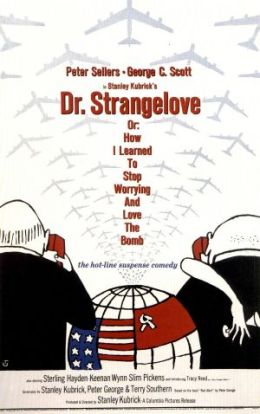
Dr._Strangelove_posterTerry Southern, who was born this day in 1924, was a writer familiar with the movies. He adapted other people’s work—freely satirizing Peter George’s thriller novel Red Alert into Dr. Strangelove—and had his own work put on screen—Buck Henry adapted Southern’s sexual fantasia Candy for film in 1968.

So, when Southern has advice about writers whose work is so (un?)lucky to be optioned by Hollywood, it’s best to listen:

If a writer is sensitive about his work being treated like Moe, Larry and Curly working over the Sistine Chapel with a crowbar, then he would do well to avoid screenwriting altogether…The wise thing, of course, is to become a filmmaker.

Note that The Three Stooges in the Sistine Chapel would have been a keeper.

Writer’s Desk: Updike on Scheduling

updike1One of the hardest things to deal with as a writer can be figuring out how much you have to do. Is it pages or hours of writing in a day that mark achievement? John Updike, who wrote a few books in his time, had a good answer:

Since I’ve gone to some trouble not to teach, and not to have any other employment, I have no reason not to go to my desk after breakfast and work there until lunch. So, I work three or four hours in the morning, and it’s not all covering blank paper with beautiful phrases. You begin by answering a letter or two. There’s a lot of junk in your life as a writer and most people have junk in their lives. But, I try to give about three hours to the project at hand and to move it along. There’s a danger if you don’t move it along steadily that you’re going to forget what it’s about, so you must keep in touch with it I figure. So once embarked, yes, I do try to stick to a schedule.

“Most people have junk in their lives.” That seems like almost the best part of what he says. Don’t pretend that you can perfectly shut the world out and be in your little writing cocoon. Deal with the noise, bring it in, and move past it to get on with your work. That seems key.

(h/t: Open Culture)

Writer’s Corner: Dreaming on Paper

satanicverses1Last November, Salman Rushdie gave a talk at Dartmouth about magic realism, among other things. As part of the talk, he provided an important caveat to the well-worn “write what you know” dictum: “… if what you know is interesting.”

Rushdie elaborated:

Write what you don’t know. One way to do this is to leave home and go find a good story somewhere else. The other solution is to remember that fiction is fictionable and try to make things up. We’re all dreaming creatures. Dream on paper…

Writer’s Desk: Get It Down

MakeGoodArt_Hardback_1359996371

This series has been visited by the great Neil Gaiman more than once. There’s a reason for that. In between all his other work, the guy manages to keep up a regular torrent of thoughts and advice on the witchy craft of writing that are rarely short of inspirational.

Recently, he’s been doing this on Tumblr. Here’s his response to a question from a fan who’s been having a hard time getting their “amazing ideas” down on paper:

Write the ideas down. If they are going to be stories, try and tell the stories you would like to read. Finish the things you start to write. Do it a lot and you will be a writer. The only way to do it is to do it.

Gaiman goes on to tell the real way to write; it involves five golden berries, five white crows, and reciting the whole of Fox on Sox. Who knows? Maybe that way works, too.

(h/t: Galley Cat)

Writer’s Corner: Kill Your Cliches

nightwomenMarlon James, the Booker Award-winning author of The Book of Night Women and A Brief History of Seven Killings, has some advice on cliches, presented as a series of questions to the struggling writer.

A few selections:

  • “How many times can the sun kiss you before it gets inappropriate?”
  • “If noise keeps assaulting your ears can you file a complaint?”
  • “Why are pipes always leaking, heat always sweltering, breezes always gentle, rain always soft, eyes always blue, streets always busy, holes always gaping, horses always wild, wind always gusty, and nails always rusty?”

Cliches are ever lurking in your mental toolbox, ready to jump onto that page without your even noticing. Be alert, be aware.

Writer’s Desk: When Inspiration Talks, Listen

MoviegoerWalker Percy, in The Paris Review, on the first piece of writing he ever had published:

…I was sitting around Saranac Lake getting over a light case of tuberculosis. There was nothing to do but read. I got hold of Susanne Langer’s Philosophy in a New Key in which she focuses on man’s unique symbol-mongering behavior. This was an eye-opener to me, a good physician-scientist brought up in the respectable behaviorist tradition of UNC. and Columbia. I was so excited, I wrote a review and sent it to Thought quarterly. It was accepted! I was paid by twenty-five reprints. That was enough. What was important was seeing my scribble in print!

As an origin story, it’s not the sort of thing that everybody could follow. After all, Percy had studied science and was a doctor before transitioning to being a writer. But it goes to show that inspiration can strike you practically anytime, anywhere. Even if you have tuberculosis. You just have to keep your ears open.

Writer’s Desk: Merton on Ignoring Criticism

Thomas Merton, who was born this day in 1915, was one of the 20th century’s only mystics whose voluminous writings on spirituality and philosophy were read with as much eagerness by the general public as by his fellow Catholics. As a prominent Catholic who directly engaged with Eastern religions and philosophies later in his life, and an eager debater, Merton was used to criticism as well as acclaim.

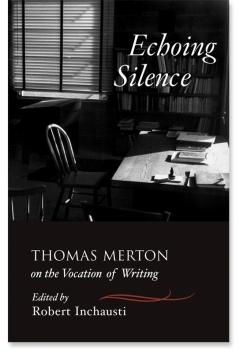
merton1A note of warning about being too cautious comes from Merton’s New Seeds of Contemplation, collected in Echoing Silence: Thomas Merton on the Vocation of Writing:

If a writer is so cautious that he never writes anything that cannot be criticized, he will never write anything that can be read. If you want to help other people you have got to make up your mind to write things that some men will condemn.

Note Merton’s focus on service. He is saying that if you’re going to write anything worthwhile, you have to ignore your inner censor, but in addition to that he sees worthy writing as being something that helps others. Whether he meant that in the strict sense, of advocating for people’s rights, or in the broader definition of expanding minds and perceptions (even just a little) with your art, the message seems to be the same: If nobody hates your writing, you might be doing something wrong.

Writer’s Desk: The First Draft

baudelaire

Jane Smiley on getting out of your own way:

… you cannot be judging yourself as you write the first draft—you want to harness that unexpected energy, and you don’t want to limit the possibilities of exploration. You don’t know what you’re writing until it’s done. So if a draft is 500 pages long, you have to suspend judgment for months. It takes effort to be good at suspending at judgment, to give the images and story priority over your ideas…

I think there are two kinds of sentences in a rough draft: seeds and pebbles. If it’s a pebble, it’s just the next sentence and it sits there. But if it’s a seed it grows into something that becomes an important part of the life of the novel. The problem is, you can’t know ahead of time whether a sentence will be a seed or a pebble, or how important a seed it’s going to be…

This, of course, is easier said than done. We’ve all been stuck at the desk, agonizing over the drivel we’ve been turning out and questioning the entire vocation. But just stick with it and (for a little while at least) ignore the inner critic. If you don’t have any raw material to work with, then there’s nothing to chisel and hone into something beautiful later on.

Writer’s Desk: Theroux on Travel Writing

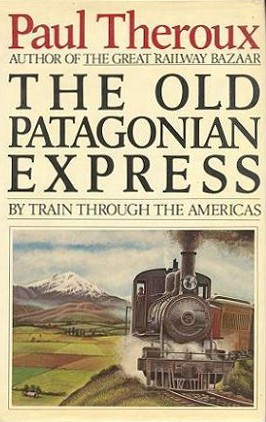
TheOldPatagonianExpressFor the 2011 release of his bibs-and-bobs collection The Tao of Travel, Paul Theroux had an interview in the Atlantic where—after noting that “Blogs look to me illiterate, they look hasty, like someone babbling”—he dispensed some advice to those in the travel-writing game:

The main shortcut is to leave out boring things. People write about getting sick, they write about tummy trouble, they write about having to wait for a bus. They write about waiting. They write three pages about how long it took them to get a visa. I’m not interested in the boring parts. Everyone has tummy trouble. Everyone waits in line. I don’t want to hear about it.

It’s probably not advice that most travel writers want to heed. After all, once you’ve spent three months in Siberia racking up expenses, you sure as hell better have something that the magazine is going to want to print. If nothing happens, embellishment or poetic license might seem more enticing.

Theroux also suggests to travel light:

The minimum is a change of clothes, a book, a toothbrush, notebooks, an extra pen. I don’t bring extra shoes. Just the necessities. I travel with a small duffel bag that fits under a seat on the plane, as well as a briefcase. The briefcase is my office. I’m always happier when I don’t have a lot of stuff.

The fewer things you have, the less you’ll pay attention to them. A pen, some paper, and your eyes and ears are all you need.

Writer’s Desk: Beerbohm on Writing’s Weakness

Max Beerbohm, self-caricature, c.1897.

Caricaturist of some note and essayist beyond compare, Max Beerbohm (1872–1956) was one of those serenely talented Victorian aesthetes one not only doesn’t see anymore, one can barely imagine walking the planet. He understood that one of the great rules of writing is this: Never let them see you sweat. If you make it seem easy, that relaxes the reader.

Not that it wasn’t work. Beerbohm:

Writing, as a means of expression, has to compete with talking. The talker need not rely wholly on what he says. He has the help of his mobile face and hands, and of his voice, with its various inflexions and its variable pace, whereby he may insinuate fine shades of meaning . . . but the writer? For his every effect he must rely wholly on the words that he chooses, and on the order in which he ranges them, and on his choice among the few hard and fast symbols of punctuation. He must so use those slender means that they shall express all that he himself can express through his voice and face and hands or all that he would thus express if he were a good talker…

When talking, we have all the senses to work with. With writing, there is really just one. But great writing, even with such a narrow toolset to work with, can nevertheless excite every single one of the senses.

(h/t Gopnik)

Writer’s Desk: Stephen King on His Muse

Calliope -- she was the muse responsible for those writing epic poetry. (Library of Congress)
Calliope — she was the muse responsible for those writing epic poetry. (Library of Congress)

There are writers who like to talk about their muse. They don’t have to necessarily be thinking about one of the classical nine Greek muses, just trying to personify that indefinable thing which is inspiration. It’s an easy thing to wax poetic about because, well, most writers don’t truly understand this thing that we do.

Stephen King has his own way of describing his muse, when talking about his writing room:

My muse is here. It’s a she. Scruffy little mutt has been around for years, and how I love her, fleas and all. She gives me the words. She is not used to being regarded so directly, but she still gives me the words. She is doing it now. That’s the other level, and that’s the mystery. Everything in your head kicks up a notch, and the words rise naturally to fill their places. If it’s a story, you find the scene and the texture in the scene. That first level — the world of my room, my books, my rug, the smell of the gingerbread — fades even more. This is a real thing I’m talking about, not a romanticization. As someone who has written with chronic pain, I can tell you that when it’s good, it’s better than the best pill.

Is that helpful to somebody struggling with the blank page? No, of course not. What’s helpful is how King ends the piece:

My muse may visit. She may not. The trick is to be there waiting if she does.

Meaning that being a writer is somewhat like being a Boy Scout. Always be prepared.

Quote of the Day: Memorial Day Edition

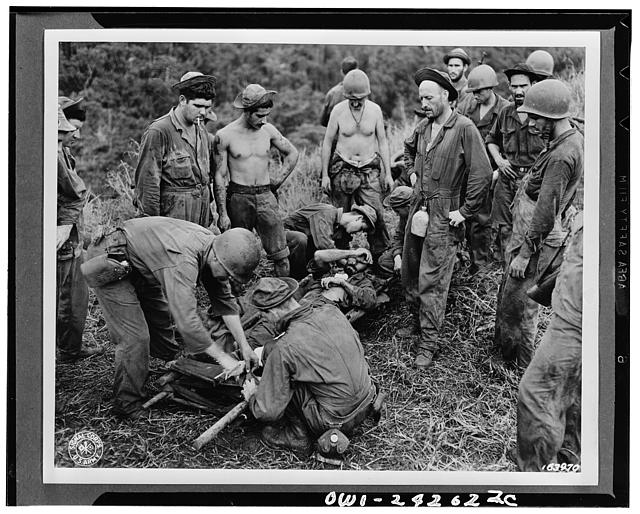
A casualty is ready for transport from the front line during the battle for Guadalcanal. (Library of Congress)
A casualty is readied for transport from the front line during the battle for Guadalcanal. (Library of Congress)

For this Memorial Day, a reminder from one of our great novelists of warfare and what it does to the men who take part in it, willingly or not:

This book is cheerfully dedicated to those greatest and most heroic of all human endeavors, WAR and WARFARE; may they never cease to give us the pleasure, excitement and adrenal stimulation that we need, or provide us with the heroes, the presidents and leaders, the monuments and museums which we erect to them in the name of PEACE.

That’s from James Jones’ The Thin Red Line (1963) which follows the battle for a fictitious Pacific island and draws heavily upon Jones’ combat experience during World War II. Although his dedication shows a tongue planted firmly in cheek, the novel that follows is one of the deepest felt, most bruising things a man ever put to page.