
Readers’ Corner: New York’s Hidden Library

The New York Public Library's Main Reading Room.
The New York Public Library’s Main Reading Room.

When you think “New York” and “library” there’s really only one that comes to mind: the grand main branch on Fifth Avenue facing Bryant Park. It’s gorgeous, it’s iconic, they have just about every book you can imagine (even if they’ve started trying to move a bunch of titles off-site); in other words perfect. The main Brooklyn branch on Grand Army Plaza is no slouch, either, either in architectural grandness or selection.

But there’s another library worth mentioning, and that’s the one underneath the Surrogate’s Court building in downtown Manhattan that nobody knows about: the City Hall Library. From last Tuesday’s New York Times:

Below the library are the cavernous storerooms and vaults that contain some of the maps, books, photographs and other items that are part of the Municipal Archives. They document the city’s government and leadership dating back to the unification of the boroughs into New York City in 1898, and back to the first mayor of the city, Thomas Willett, in 1665.

The history of the city is celebrated in old sepia photographs, wall-size topographical maps and reproduction manuscripts on display within the library and in a visitor center next to the library.

Yet there is not a hint of any of this on the granite exterior of the imposing Beaux-Arts building at 31 Chambers Street, behind City Hall….The librarians say the courthouse’s status as a designated landmark means that they are not allowed to hang a sign on the building’s exterior.
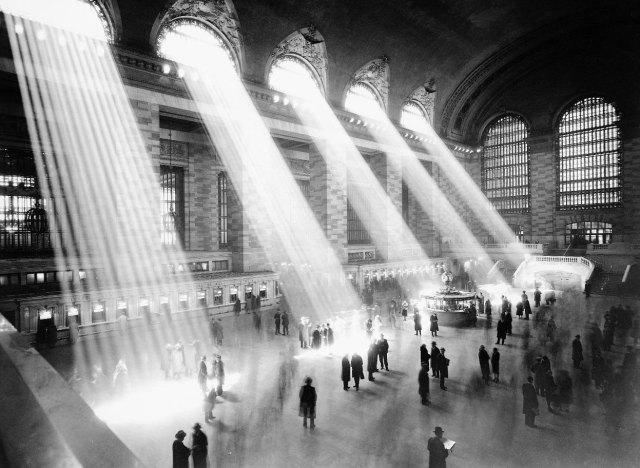
Grand Central Station, circa 1937 - one of the images available from New York city's Municipal Archives.
Grand Central Station, circa 1937 – one of the images available from New York city’s Municipal Archives.

If you can’t get there, though, no worry: Much of the Municipal Archives’ photographic holdings were digitized and put online last year—the interest was so immediate that it crashed the server. It’s an astonishing collection of historical imagery, which you can see here. Many of the old glass-plate negatives that the NYPD shot of crime scenes back in the early 20th century were used by Luc Sante in his ghostly book, Evidence.


New in Theaters: ‘2 Days in New York’

If you’re looking to improve box office, it might make sense to replace Adam Goldberg with Chris Rock. As a leading man opposite co-star/writer/director Julie Delpy in her romantic comedy 2 Days in Paris, Goldberg chiseled a bit of comic gold, but he was hardly a draw for most moviegoers. Rock, who replaces him in 2 Days in New York, is a star with proven appeal, even if his on-screen timing has always been a poor cousin to his stage persona. But, as it turns out, this tradeoff is costly…

2 Days in New York opened last Friday; my full review is at PopMatters.

Trailer is here:

Reader’s Corner: David Rakoff (1964-2012)

It’s been a bad few weeks — the literary world has been robbed of yet another glorious voice. David Rakoff, whose print and radio essays were some of the darkest yet most violently life-affirming things you will ever encounter, died on Thursday from the cancer that first appeared when he was just 22 years old.

His books (Half Empty, and particularly Don’t Get Too Comfortable) are rich with life and haunted with death, like most of the best writing is. He served on the airwaves of National Public Radio and on the shelves of smarter bookstores everywhere as a kind of grumpy conscience, the mordant cousin to David Sedaris (who championed his early writing).

In this fantastic segment from a live-recorded episode of This American Life from just this past May, Rakoff talks about his youth, dance, what he termed “all this nonsense”, and getting on with life after an operation severed the nerves that controlled his left arm.

“I’m done with so many things,” he says with the glint of sadness which always gave his humor that unique sting.