Writer’s Desk: Create What You Cannot See

Novelist and new Nobel Prize winner for literature Annie Ernaux wrote a few years back about the influence of surrealists (Andre Breton, George Perec) on her work in her “formative years.” Part of her fascination seemed to be due to their power to make the ineffable real and graspable.

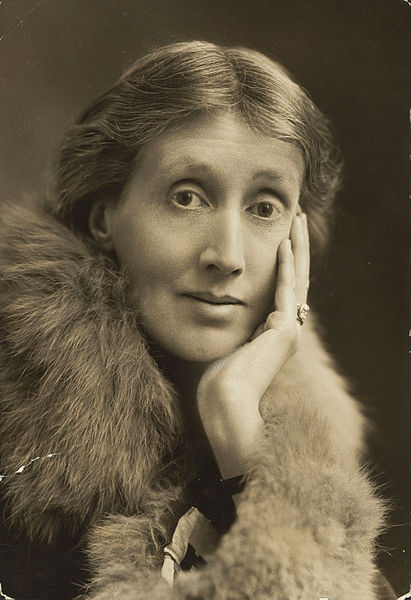
In her piece, “The Art of Writing,” Ernaux also delves into Virginia Woolf (another influence in her youth) and her views of writing, which also seemed focused on bringing something into view that was previously unseen. Here Ernaux quotes Woolf writing to Vita Sackville-West:

I believe that the main thing in beginning a novel is to feel, not that you can write it, but that it exists on the far side of a gulf, which words can’t cross; that one can draw it to oneself: it’s to be pulled through only in a breathless sigh…

What Woolf proposes is in some ways a paradox. “Words can’t cross”? But perhaps she is saying that writing can be less about the words themselves than the imagination that powers them. Visualize your book, feel it, breathe it, live it. Pull it to yourself and climb inside.

Then start writing.

Writer’s Desk: Invite the Reader In

In her essay “Mr. Bennett and Mrs. Brown“, Virginia Woolf described the phantom form that books can take for writers, a little figure (who identifies in this instance as “Brown”) and says “Catch me if you can.” That infuriating chase makes up the bulk of a writer’s life:

And so, led on by this will-o’-the-wisp, they flounder through volume after volume, spending the best years of their lives in the pursuit, and receiving for the most part very little cash in exchange. Few catch the phantom; most have to be content with a scrap of her dress or a wisp of her hair…

And what to do when you have finally caught the phantom? How to bring the reader in to witness the glory of your catch? Treat them as a guest:

The writer must get into touch with his reader by putting before him something which he recognises, which therefore stimulates his imagination, and makes him willing to co-operate in the far more difficult business of intimacy. And it is of the highest importance that this common meeting-place should be reached easily, almost instinctively, in the dark, with one’s eyes shut…

If you give the reader something familiar to hang on to, they will be more likely to follow you anywhere.

(H/T: LitHub)

Quote of the Day: Virginia Woolf and New Media Distraction

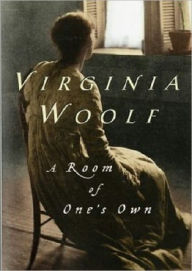
roomofonesownVirginia Woolf reviewed books for years. It was a decent job, and necessary for survival; incredibly one could make a living, albeit a poor one, doing that back then.
But occasionally the whole business of opinionating got to her. In a 1939 essay, she suggested replacing book reviews with a simple stamp of approval or disapproval. In her mind this was better than what she called:

…the present discordant and distracted twitter.

Feel free to draw your own comparisons between her time and now.

Writer’s Desk: Inspiration Close at Home

Sometimes it comes easily. The words flow and the paragraphs and plot lock together with smooth and powerful precision like girders in a swiftly-built tower.

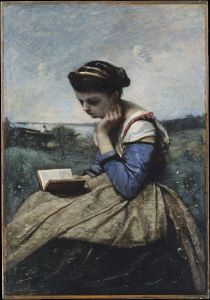
'A Woman Reading' by Camille Corot (c.1869)
‘A Woman Reading’ by Camille Corot (c.1869)

Other times (most times), it’s a struggle to get even a good page done after a full day spent at the writing desk. That’s where inspiration comes in.

But where do you find it when it goes hiding? Usually, you can’t wait, you have to just keep plowing ahead.

In a long, sprawling piece for the New York Review of Books called “Inspiration and Obsession,” Joyce Carol Oates describes how what can seem casual and inspired is really the result of hard labor:

[Emily] Dickinson’s poems, and her letters as well, which seem so airy and fluent, give the impression of being dashed off; in fact, Dickinson composed very carefully, sometimes keeping her characteristically enigmatic lines and images for years before using them in a poem or in a letter.

Sometimes it can help to simply look to one’s own life. That of course can lead to too much of the bildungsroman we see in modern fiction (one of the reasons we see so many wealthy, educated characters and so few poor, unless it’s crime fiction). But sometimes it can open the spigot; Oates calls it being “a time traveler” in your own life. She quotes Virginia Woolf, who found great success this way:

I am now writing as fast & freely as I have written in the whole of my life; more so—20 times more so—than any novel yet. I think this is the proof that I was on the right path; & that what fruit hangs in my soul is to be reached there…. The truth is, one can’t write directly about the soul. Looked at, it vanishes: but look [elsewhere] & the soul slips in.

So there’s one road to inspiration, when all else fails. Look at your own life, but from an angle.

Department of Weekend Reading: October 31, 2014

reading1