The thing with writer’s block is that there’s no way to get around it but by writing. That’s where the prompt can come in handy.
At Poets & Writers, they have a handy resource that churns up a steady stream of prompts to get you going on that project, regardless of what it is, from creative nonfiction (always a tricky category) to fiction.
Here’s a few:
This week, take a straightforward scene you’ve been working on and insert an awkward mistake made either by a major or minor character.
Do you have a time period you routinely set your stories in? This week, choose a story you’re struggling with and reimagine it in a different decade or century.
This week, write about a time when you were out of your element, immersed in a community or culture that you felt was very different from your own. Observe your own behavior as an anthropologist would.
You might want to toss the results away when you’re done. But at least you’ll be writing.
“Where do you find the time?” That may be one of the questions writers hear the most. It’s heard just about as often as “Where do you get your ideas?” and is possibly as hard to answer.
The most likely response is, “I have no idea.” Every writer tries to carve off little pieces of time here and there. But none of us live in a vacuum. Family, work, joy—There are lives to be led, after all. Because of the time crunch difficulty, advice can help.
As a single working mom of two, [Toni Morrison] carved out a few minutes to write before bed. She cranked out The Bluest Eye in that time.
I absolutely refused to go to sleep until I’d written 500 words. This was a ridiculously small goal for each night but I found that this was my own personal ‘hump.’ If I could get to 500 I could usually get to at least 1,500
When you have a big goal, you may need to turn down opportunities or invitations, or let go of a few responsibilities. Sometimes people feel guilty about this, but people who care about you will likely support you, especially if there’s an end in sight.
It’s not always about inspiration. Sometimes it can be about what you’re willing to give up. How important is writing to you in the end? If you’re not sure about how to answer that question, you may have your answer.
It looks as though the grave of the Western world’s first true novelist might have been found at a 17th century convent in downtown Madrid. According to NewsHour:
Cervantes died the same week as William Shakespeare in 1616. He had requested to be buried at the convent where he was found. Luis Avial, the georadar expert on the team, said at a news conference on Tuesday that Cervantes’ remains will be reburied at the same convent, after a tomb has been built…
Cervantes didn’t just create the modern novel with the satirical mock-epic (and bestseller) Don Quixote—Japanese noblewoman Murasaki Shikibu is normally credited with penning the first novel, The Tale of Genji, in the 11th century—he also lived a life that most novelists could only dream of.
One of the more notable episodes came when the larger-than-life writer’s years of incarceration by Moorish pirates was put to an end in part by a ransom paid by the Convent of the Barefoot Trinitarians, the order of nuns whose convent ultimately became his resting place.
Writers aren’t known for their eagerness to take advice. Some work well in collaborative environments where their text is ever being reworked by colleagues (newsrooms, say). But in the main, their tendency is resistance to outside meddling. It’s a common side effect of the stubbornness needed to sit down at that desk every day, even when the sun is shining and the last thing they want to do is grind out another couple pages of that damn novel.
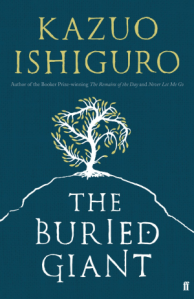
It was refreshing, then, to read this in a recent profile of Kazuo Ishiguro, whose newest novel The Buried Giant is hitting stores soon. According to Ishiguro, he asked his wife to read his first pages:
“She looked at it and said, ‘This will not do,’ ” he recalled. ” ‘I don’t mean you need to tweak it; you need to start from scratch. None of this can be seen by anybody.’ “
He put the book away and didn’t go back to it for six years. It’s impossible to say, of course, whether Ishiguro’s wife was correct. But what’s almost certain is that more writers would be better off listening to that trusted confidant when they say, albeit lovingly: Don’t show this to anybody.
Like any other type of advice, there’s writing advice you want to hear that’s not terribly helpful, and writing you don’t want to hear that’s also probably what you need to hear.
Once or twice I got a chance to work with [Atlantic editor] Bill Whitworth on a piece or two — and I was just kind of struggling to support myself and, you know, life is busy and I wasn’t writing that much. He just said very simply, “Are you writing every day?” and I said, “Ummmm,” and I sort of mumbled because I couldn’t say yes.
It was a horrible feeling, and the day after that, I started writing every day … I fudge a lot where I think, “OK, did you write anything, did you write a text? Did you write an email? Did you write just notes on a scrap of paper? Did you write something?” So that’s how I get around it sometimes, by stretching the definition.
Let’s face it, there’s almost always something more fun to do than write on any given day. I mean, those socks aren’t going to organize themselves, are they? But if you get in the every-day habit, eventually it will become hard to break.
When an author’s resume includes such masterpieces as the Barrytown trilogy (The Commitments, The Snapper, The Van), it’s generally best to listen to what they have to say…at least when it comes to writing.
Do be kind to yourself. Fill pages as quickly as possible; double space, or write on every second line. Regard every new page as a small triumph — Until you get to Page 50. Then calm down, and start worrying about the quality. Do feel anxiety — it’s the job.
James Patterson is seen at times as more machine than writer. There’s good reason for this. His advertising background; those couple dozen credited co-writers; a happy malleability when it comes to genre (romance, YA, mystery, whatever); multiple books a year; nearly $100 million in annual revenue.
All that being said, it’s helpful to remember that at one point even Patterson was a wannabe, just another unpublished novelist trying to get his book out there. From Todd Purdum’s profile for Vanity Fair:
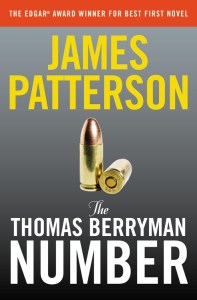
His first novel, The Thomas Berryman Number, about a Nashville newspaperman on a murderer’s trail, was rejected by 31 publishers before Little, Brown published it, in 1976. It won the Edgar Award for best first novel from the Mystery Writers of America, but sold only about 10,000 copies…
Selling 10,000 copies of anything would be a dream come true for most authors. Still, success as a writer is never guaranteed. Even for the man who accounted for one of every 26 hardcover novels sold in the U.S. during 2013.
Now that the dream of the Amtrak writers’ residency is over and done with, it’s time for the rest of us to get back to the business at hand: crafting words and pages from nowhere out of nothing. Place matters; thusly the desire for inspiring places to put fingers to keyboards.
But there’s always that unfortunate reminder that, dream though we may of the perfect place and time to do one’s writing (cabin, nice view of the lake, maybe a dog who only wants to be walked at convenient 3- to 4-hour intervals), at some point one does have to get past inspiration and put one’s tender nose on that unforgiving grindstone.
Per Doreen Carvajal, who wrote about using the TGV train ride south from Paris as a way to unblock a long-dormant book proposal:
I settled into a cushioned seat by the window, thinking of my own family’s love affair with trains and the basic writing lesson they knew better than me. There is no better way to craft a book than to toil like a railroad worker, every day, all day.
There has been a lot of talk over the past few years about the worth of creative writing programs. They’ve been long derided as factories for bloodless mediocrity, churning out legions of well-schooled kids told to write what they know, when often they just don’t know that much of anything yet.
In Chad Harback’s 2010 essay, “MFA vs. NYC“, he points out that much of the hand-wringing about the churning out of “cringing, cautious, post-Carverite automatons” is besides the point:
…even if the writer has somehow never heard of an MFA program or set foot on a college campus, it doesn’t matter, because if she’s read any American fiction of the past 60 years, or met someone who did, she’s imbibed the general idea and aesthetic. We are all MFAs now.
But though Harbach’s ultimate point (which he expanded into a book earlier this year) is a sound one: writing programs are here to stay, and the real question is whether or not one should take use of them or just up and move to New York to get a toehold in the publishing industry.
One point about creative writing programs that hasn’t been much explored, though, was just raised by Junot Diaz in a piece he wrote for the New Yorker: “MFA vs. POC” (“POC” for “people of color”). As usual, Diaz doesn’t mince words when talking about his experience, and that of his other “Calibans,” as a POC in almost entirely-white writing programs:
In my workshop the default subject position of reading and writing—of Literature with a capital L—was white, straight and male … Race was the unfortunate condition of nonwhite people that had nothing to do with white people and as such was not a natural part of the Universal of Literature, and anyone that tried to introduce racial consciousness to the Great (White) Universal of Literature would be seen as politicizing the Pure Art and betraying the (White) Universal (no race) ideal of True Literature.
Even more depressing:
I remember one young MFA’r describing how a fellow writer (white) went through his story and erased all the ‘big’ words because, said the peer, that’s not the way ‘Spanish’ people talk. This white peer, of course, had never lived in Latin America or Spain or in any US Latino community—he just knew. The workshop professor never corrected or even questioned said peer either. Just let the idiocy ride.
It’s worth thinking about Diaz’s critique the next time you see the piles of new fiction filling the stores. Consider those slim volumes of short stories from the well-connected, fully MFA’d writers published in all the right magazines. A rainbow of diversity, it’s not. As Diaz says to the “students of color” who asks his advice about whether or not to stay in these programs:
…please hang in there. We need your work. Desperately.
Turns out that besides being a young preacher, scourge of the empowered classes, and essayist whose words could scorch the hair right off your head, James Baldwin was also a crack film critic, when he wanted to be.
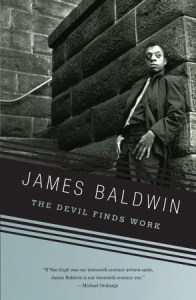
In The Atlantic, Noah Berlatsky pulls out a choice quote of Baldwin’s from his mostly ignored 1976 book The Devil Finds Work. Here, he writes about one of the decade’s two most influential horror films (the other being Halloween, just as trashy but not given as much critical deference at the time):
The mindless and hysterical banality of evil presented in The Exorcist is the most terrifying thing about the film. The Americans should certainly know more about evil than that; if they pretend otherwise, they are lying, and any black man, and not only blacks—many, many others, including white children— can call them on this lie, he who has been treated as the devil recognizes the devil when they meet.
It’s one of the reasons people hate critics, and why at least some critics (of a level with Baldwin) can actually be construed as necessary to the culture. Few people want to think about the evil that surrounds them every day; they’d rather go to the cinema and be treated the indulgent thrills of imaginary threats (demons, and the like).
The critic who reminds us of our short-sightedness is rarely rewarded for doing so.
S.J. Perelman specialized in a particularly adroit style of urbane humor, which he deployed for decades at the New Yorker and in the occasional Marx Brothers script (the latter of which earns him automatic inclusion in any writers’ Hall of Fame).
He also had some salient advice for writers, not necessarily about the act of writing itself, but what writers had to look forward to in their choice of such a “shabby-genteel” career:
My vocation, it may have leaked out to you, is that of a writer, which means that I sit in a hot little room stringing words together like beads at so many cents per bead. It’s shabby-genteel work and, on the whole, poorly paid, but I’m too fragile to drive a brewery truck and I’m too nervous to steal … In the poolrooms I frequent, it has often reached my ears that the chief advantage of being a writer is that it allows you to sleep late in the morning. Don’t believe it. You can enjoy the same privilege as a night counterman in a cafeteria, and, what’s more, in that job you can always bring home stale Danish pastries for the kiddies…
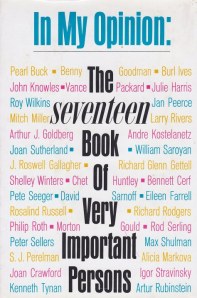
That comes courtesy of a book called In My Opinion: The Seventeen Book of Very Important Persons. Apparently back in 1966, Seventeen magazine had an advice column frequented by the likes of Perelman, Philip Roth, Pete Seeger, and Joan Crawford (?!). Maybe teenagers read back then.
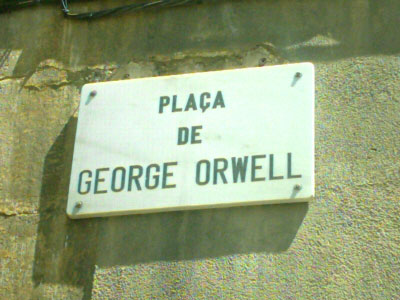
When I sit down to write a book, I do not say to myself, ‘I am going to produce a work of art.’ I write it because there is some lie that I want to expose, some fact to which I want to draw attention, and my initial concern is to get a hearing.
Ta-Nehisi Coates posted a piece in The Atlantica few days back about how to be the best kind of political-opinion journalist. His advise is well-suited for those many who make their livings opinionating throughout the Beltway mediaverse and blogosphere, but is also a good rule of thumb for writers in general:
…To paraphrase Douglass, a writer is worked on by what she works on. If you spend your time raging at the weakest arguments, or your most hysterical opponents, expect your own intellect to suffer. The intellect is a muscle; it must be exercised.
He’s talking about the bad habits of political writers, who tend to pick the most obvious strawmen to go after as a way of formulating their own beliefs. This is an attractive way of operating, but ultimately lazy.
But everybody who puts pen to paper or key to blog is well served with this advice: Don’t do what you’ve always done. This isn’t to say that all writers shouldn’t identify their areas of strength, but to never venture outside those safer realms is to risk creative calcification.
There are writers who don’t need a system to get their work done. They can go with what one could term the Stephen King method: Read a lot and write a lot. Sometimes, though, that straight-out approach doesn’t hack it. You’re blocked, you’re uninspired, you just don’t want to do it. That’s when writers resort to tricks and hacks to force themselves into productivity. Some need solitude, some need noise, some use a particular kind of writing software, some have a program on their laptop that doesn’t let them waste time on the Interwebs… The ever-precious Jonathan Franzen writes with:
noise-canceling headphones, on which I can blast frequency-shifted white noise (“pink noise”) that drowns out even the most determined woofing of a neighbor’s television set…
It goes on.
One other thing writers like to do (besides procrastinate and read their own reviews while claiming they never do so) is read or listen to more successful writers go on about their methods. The idea being, well, if it worked for Joyce Carol Oates, maybe I should try it out.
Novelist Ben Dolnick has a sharp essay about this in the New York Times called “Stupid Writer Tricks,” where he talks about his not-exactly helpful obsession with gleaning tips from writer interviews. Reading that Philip Roth likes to write at a standing desk or Hemingway always kept a small notebook on him seems like the sort of thing that might work out … until it doesn’t:
I had, for a long time, a profound vulnerability to hearing about these sorts of routines. Of course I knew that writing was terrifically hard work, and that there was no secret code, as in a video game, that would unlock Tolstoy-mode, enabling me to crank out canon-worthy novellas before lunch. But I persisted in believing that I might one day come upon some technique, some set of tricks, that would vault me irreversibly onto the professional plane. I didn’t have a working printer, but I agreed wholeheartedly with Joan Didion that I needed to be sleeping in the same room as my manuscript, so as never to lose touch with it. It would be years before I’d written so much as a single chapter of a novel, but I knew that when I finished a book, I would, like Anthony Trollope, begin my next one on the very same day.
Dolnick doesn’t chuck the whole idea of writing techniques, finding them to have their purpose. But he decides it’s ultimately more about how you approach writing than your technique; calmness is key:
If, though, you can reach out from a position of calm, as a swimmer reaches out for a kickboard before turning to begin his next lap, then you might find yourself feeling what all the tricks and tips are finally pointing toward: freedom. You might surprise yourself — roll onto your back, do a flutter kick, or just float for a while. The water, after all, is the point, and not how you scratch away at it.
Some of us might at times write more lucidly and energetically in a state of great agitation and nerve. But in the end, doesn’t it flow better when you’re actually enjoying the process? Write with joy, in other words. Unless you’re blocked, in which case, do whatever you must to make the words come.









 Chris Barsanti
You must be logged in to post a comment.