Writer’s Desk: Identify With All Your Characters

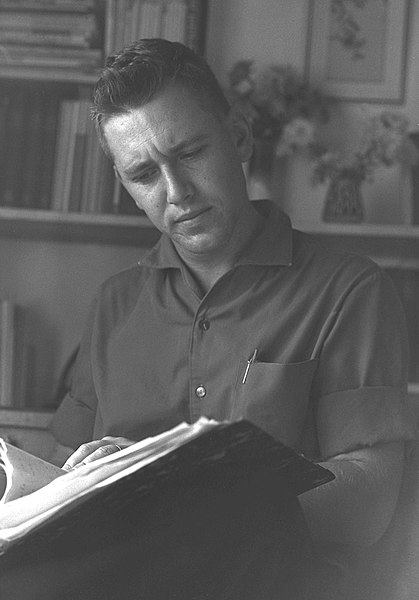
Amos Oz, 1965 (Moshe Pridan)

Because many of the novels and stories written by Amos Oz dealt in some ways with the Israeli-Palestinian conflict, they were frequently read as statements about one thing or another. Oz always rejected that formulation. His stories were grounded in history but they were about humans.

In 2016, Oz talked to The Believer about this:

Each time I have the urge in me to make a statement or send a message or to issue a manifesto, I don’t bother to write a novel. I write an article and publish it in a popular newspaper…

Referencing D.H. Lawrence’s thoughts on the subject, Oz also made a point of resisting the urge writers (and often readers) have to take sides with their characters:

He said, in writing a novel, the writer must be able to identify emotionally and intellectually with two or three or four contradicting perspectives and give each of them very a convincing voice. It’s like playing tennis with yourself and you have to be on both sides of the yard. You have to be on both sides, or all sides if there are more than two sides…

If you choose sides, you shortchange the other character or characters. They all have stories and perspectives worth hearing.

If not, why are they in your book?
Writer’s Desk: Stay Open, Stay Confident

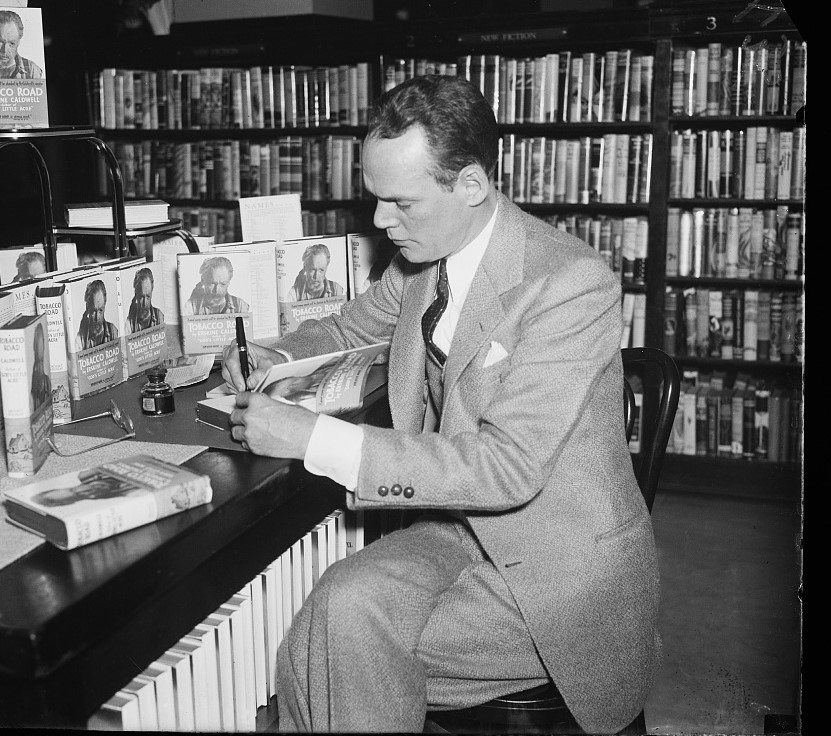
When he was interviewed by The Atlantic in the summer of 1958, Erskine Caldwell was just about the biggest author in America. The interviewer notes that Caldwell’s novel God’s Little Acre had sold over eight million copies, “more than any other novel written in our century.” An incredible achievement, especially for an author whose work does not appear on nearly any syllabi or even many greatest books of the twentieth century lists these days (excepting perhaps Tobacco Road).

Still, given those numbers, Caldwell had reason to be confident:

It’s not that I don’t welcome criticism from a publisher or a reader or an editor, it’s just that I think I know more about it than he does…

And he was probably right.

Stay open to feedback. We all need it. But always remember there’s a chance that you may actually know what you are doing.

Writer’s Desk: Write with Conviction and Humility

In a recent piece for the New Yorker that ranged from George Orwell’s Why I Write to Ta-Nehisi Coates’ new book The Message, Jay Caspian Kang grapples with a problem that can bedevil some of us who make words as a vocation: How much does our writing matter, and should it?

Writers, dramatic and vain by nature, seem particularly ill-suited to offer wisdom. Perhaps there are some lessons to be gleaned from a lifetime of reading and typing, but if they exist they’ve mostly hidden themselves from me. Call me a cynic, but I’ve grown to see writing as a vocation that should be performed dutifully, with ample amounts of irony and self-deprecating humor. This isn’t to say that writing can’t influence politics or provide hope, but I am not sure that anyone can really set out to achieve that goal. Our job is to type…

Kang is not arguing that writing cannot be used to advance a larger purpose. Drawing on a talk he once heard from George Saunders, Kang posits that when writing, “you type, tie it together, and hope that, more often than not, something resonates.”

The trap that writers can set for themselves, Kang believes, is setting expectations for their work which exceeds their abilities:

I do not think it is the job of writers to “save the world,” nor do I think they should set out to do so—not out of any objection about the sanctity of art for its own sake but, rather, because the pressure to always be political, significant, or weighty leads to leaden, predictable prose…

Do good work. Hope that this will resonate and connect with readers in a way that enriches them and even broadens their perspective.

Just do not expect to change the world.

Writer’s Desk: Residency in Red Wing

Anderson Center at Tower View, near Red Wing, Minnesota

Near the town of Red Wing, Minnesota is the estate of Dr. Alexander Pierce Anderson, who made some millions by creating things like Quaker Puffed Wheat. Since 1995, the Anderson Center has hosted residencies for artists from around the world.

It costs $30 to apply. Selected writers will have two- or four-week residences at the Center with beautiful accommodations, work spaces, meals, and even transportation to and from the airport if you are coming from out of town.

Here’s a video about the application process:

Writer’s Desk: Do It, Don’t Talk About It

In her book Making a Literary Life: Advice for Writers and Other Dreamers, Carolyn See has a lot to say about how to survive and even thrive in the writing life.

In part, she does this by keeping it simple. She includes practical asides about what will be demanded of you, though what she says does help (“A thousand words a day—or two hours of revisions—five days a week for the rest of your life”).

See also reminds writers what not to do:

You know the last thing in the world people want to hear from you, the very last thing they’re interested in? The fact that you always have wanted to write, that you cherish dreams of being a writer, that you wrote something and got rejected once, that you believe you have it in you-if only the people around you would give you a chance-to write a very credible, if not great, American novel…

Writer’s Desk: Epiphanies are Cheating

Photo by Ritika Roy (licensed under CC-CC0 1.0)

Novelist and writing professor Charles Baxter was reading a Best American Short Stories volume when he realized something: Every story seemed to end the same way:

I kept coming upon final pages in which there was a moment when a character stopped and looked off into the distance, and then a sentence the equivalent of ‘Suddenly she realized…’ appeared…

For Baxter, this seems like cheating:

If you’re trying to write a story with a beginning, middle, and end but haven’t found a way of tying it up dramatically, an epiphany will do the job. But it often ends up feeling like a shortcut, and besides … I’ve had so god-damned few epiphanies in my life that I’m suspicious of them…

Beware of the easy conclusion.

Writer’s Desk: Look Outside

Built-in desk at Fallingwater

Anne McCaffrey (Dragonriders of Pern series) moved from America to Ireland, where she enjoyed, among other things, the “lovely vistas.” It’s not something that most writers can manage, of course. But she made a good point about the importance of having something to look at:

I think writers need windows on a view to remind them that a whole world is out there, not the minutiae with which they might be dealing on a close scale…

Writer’s Desk: Design It Yourself

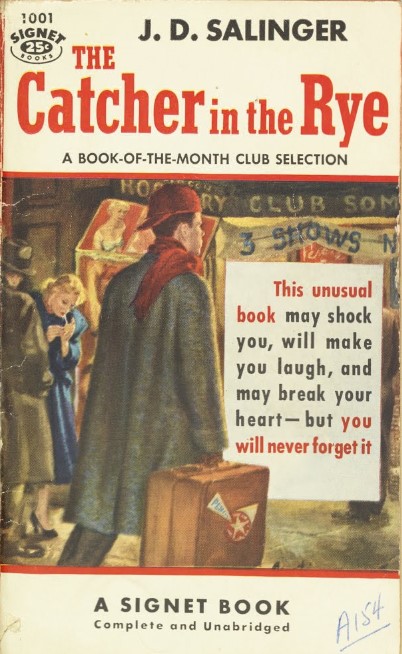
When J.D. Salinger saw the Signet paperback cover for his novel The Catcher in the Rye, with a very literal painting of Holden Caulfield wandering the sordid streets of New York, like many authors, he was displeased. Unlike many authors, he took matters in his own hand.

One of the more famous of the book’s many covers was its mass market Bantam edition, featuring the very familiar stark white design and rainbow stripes cutting across the upper left corner.

According to LitHub, Salinger designed it himself.

Most authors have very little control over how their books are presented. But whenever you have the opportunity to make any decisions about design, marketing, or anything else involved in the packaging of your work, seize it.

Who knows? You might design a cover that could last for more than a half century.

Writer’s Desk: Work to Create

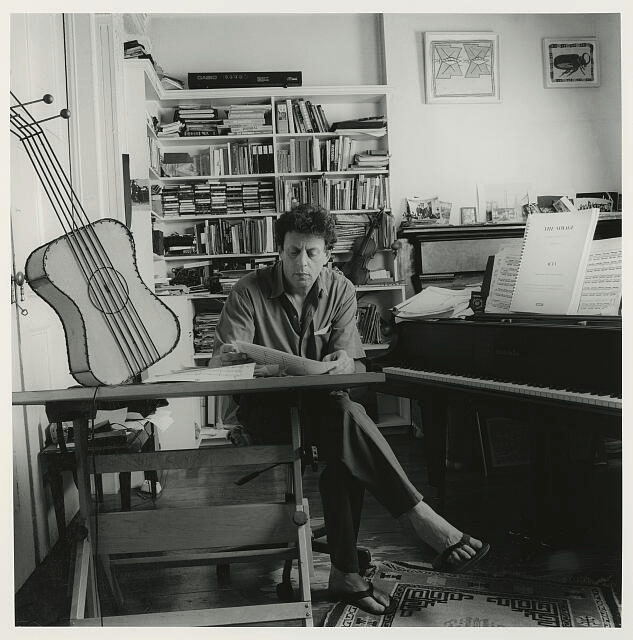
Philip Glass (Nancy Lee Katz, 1992)

In the 1970s, Philip Glass had become an American composer to watch. Celebrated and also vilified, his minimalist work got attention. But it didn’t pay the bills. In fact, Glass lost money pretty much every time he took his ensemble on tour. So how did he get by? The son of Baltimore immigrants, Glass did whatever he had to do. Working a crane at a steel foundry. Driving a New York cab in the Taxi Driver days. Running his own moving company (sometimes advertised in the Village Voice as Prime Mover). Also being a self-taught plumber.

Which led to this encounter when Glass was installing a dishwasher in a Soho loft sometime in the 1970s:

While working, I suddenly heard a noise and looked up to find Robert Hughes, the art critic of Time magazine, staring at me in disbelief. ‘But you’re Philip Glass! What are you doing here?’ It was obvious that I was installing his dishwasher and I told him I would soon be finished. ‘But you are an artist,’ he protested. I explained that I was an artist but that I was sometimes a plumber as well and that he should go away and let me finish…

The very obvious moral of this story? Some artists have sponsors. They are the lucky ones. For the rest of us, do what you have to do to pay for paper, toner ink, and the electric bill.

Even if that means installing an art critic’s dishwasher.

(h/t Ted Gioia)

Writer’s Desk: Writing Solves Problems

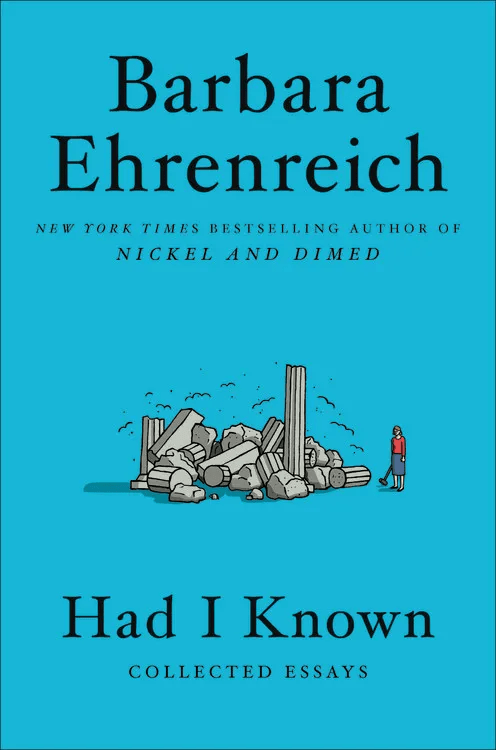
When she was a teenager, Barbara Ehrenreich (Nickel and Dimed) started journaling, as many of us do. After penning the usual things (what was happening in her life, thoughts about books she was reading), she realized there was a purpose for the journal.

It was a tool. As she wrote in Granta:

I had discovered that writing – with whatever instrument – was a powerful aid to thinking, and thinking was what I now resolved to do. You can think without writing, of course, as most people do and have done throughout history, but if you can condense today’s thought into a few symbols preserved on a surface of some kind – paper or silicon – you don’t have to rethink it tomorrow … The reason I eventually became a writer is that writing makes thinking easier…

Sometimes you have to write your way through something to understand it. You may even have to start writing without knowing your destination. Writing orders your thoughts, whatever they are.

Writer’s Desk: Keep Things Vague

In 1972, Jorge Luis Borges was a sage of literature. Seventy years old, blind, and feted around the world for his delicately phantasmagoric fiction, he was visited by Fernando Sorrentino, a dedicated fan. They talked for a week.

Here’s a piece of advice Borges gave Sorrentino, noted by Faena Aleph:

I believe that a writer should never attempt a contemporary theme or a very precise topography. Otherwise people are immediately going to find mistakes. Or if they don’t find them, they’re going to look for them, and if they look for them, they’ll find them. That’s why I prefer to have my stories take place in somewhat indeterminate places and many years ago…

Anybody who has written or tried to write fiction with specific contemporary settings which depart in any way from their lived experience knows what he is talking about. Doing such work requires a lot of work that goes beyond writing. Research, interviews, all of it.

That doesn’t mean it isn’t worthwhile. If everybody wrote like Borges, we would have no Dreiser, Wolfe, Bellow, and so on. But there is something to be gained from just writing a story of sensation, thoughts, and actions with no or little regard for where it takes place.

If nothing else, it’s liberating.

The Writer’s Year 2025 calendar is on sale now.

Writer’s Desk: Don’t Be Afraid of the Fear

Rita Dove: An American Poet (Eduardo Montes-Bradley)

At some point it gets easier. Eventually you have written enough that the panic and indecision just disappears. At that point, the words flow like fine wine. Isn’t that how it works?

Not necessarily. Consider Rita Dove. A Pulitzer-winning poet and recipient of the National Humanities Medal, she was also the U.S. Poet Laureate from 1993 to 1995. As the poetry business goes, Dove is pretty close to its peak.

In this 2016 interview, she talks about the confidence that comes from her long career:

The process has become a lot easier because even in the depths of despair—which happens more often than people might imagine—I have the example of all the other poems I’ve written and I know I’ve been through this before, so things will probably turn out fine…

But alongside that self-assurance (I can do this. I’ve done it before) is that nagging problem every writer faces now and forever (But can I?):

I’m still terrified every time I approach a fresh page…

If you are lucky enough to be successful as a writer, don’t assume that everything will suddenly become clear. It probably won’t. But that uncertainty, the not knowing, that’s where creation lives.

The Writer’s Year 2025 calendar is on sale now.

Shameless Self-Promotion: ‘The Writer’s Year 2025’ on Sale Now

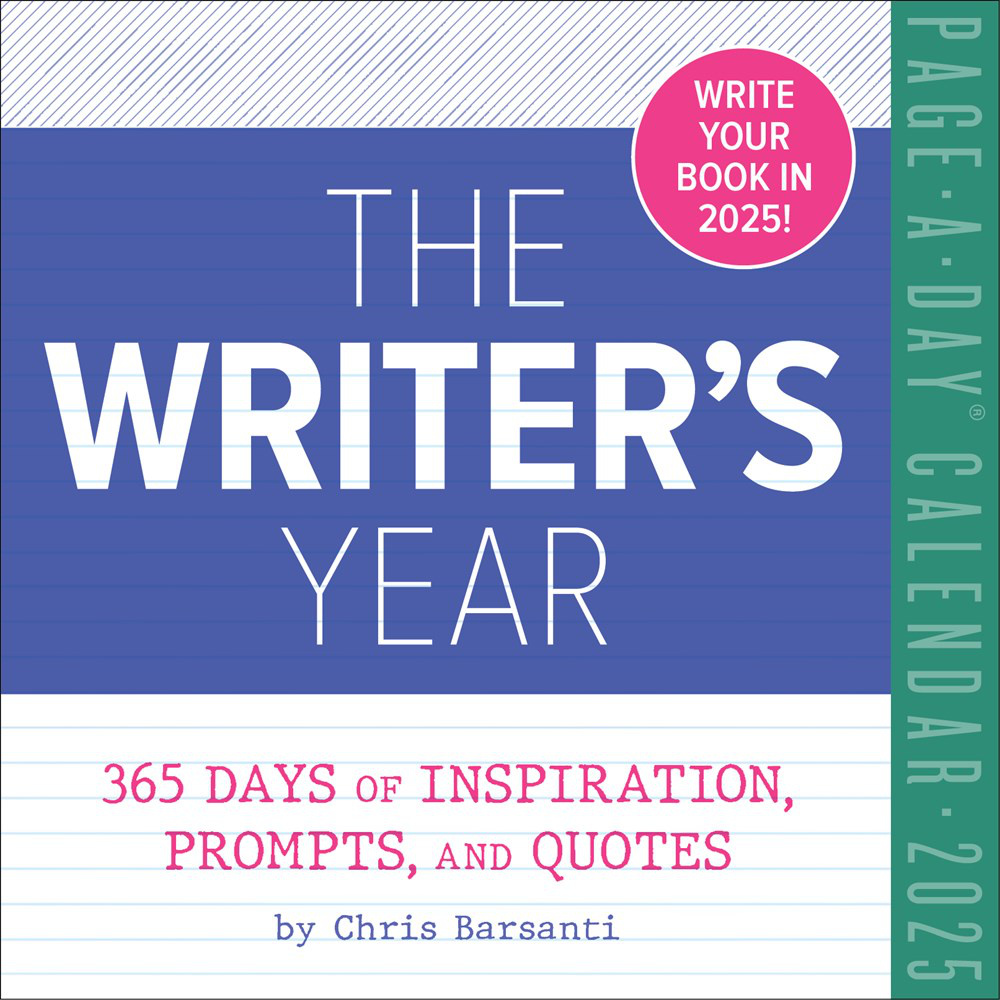
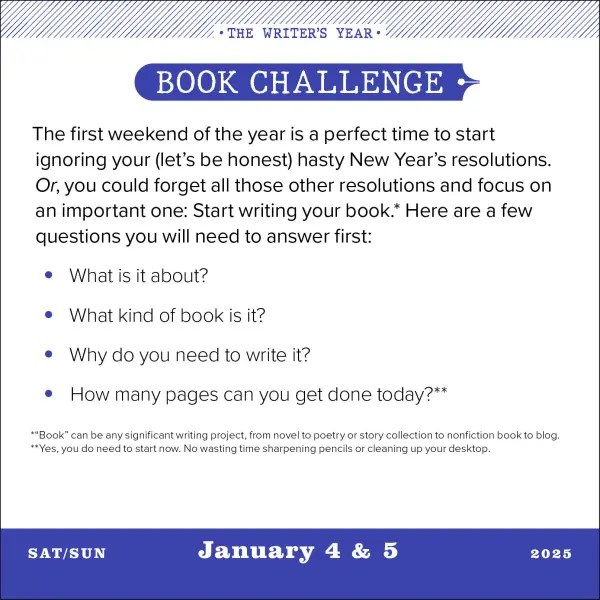
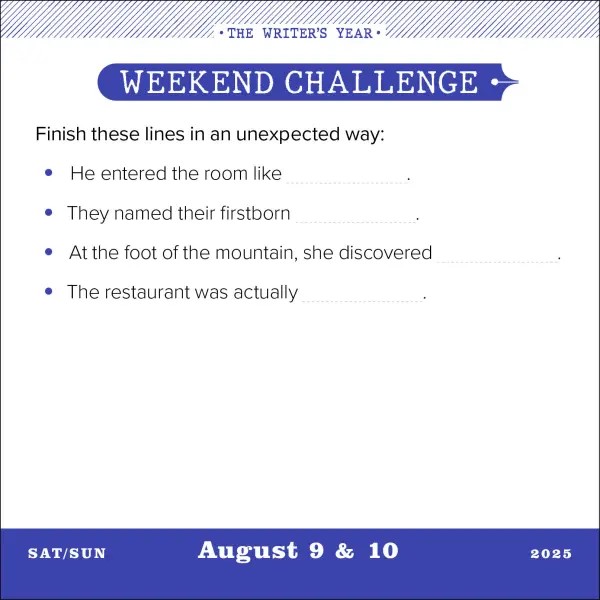
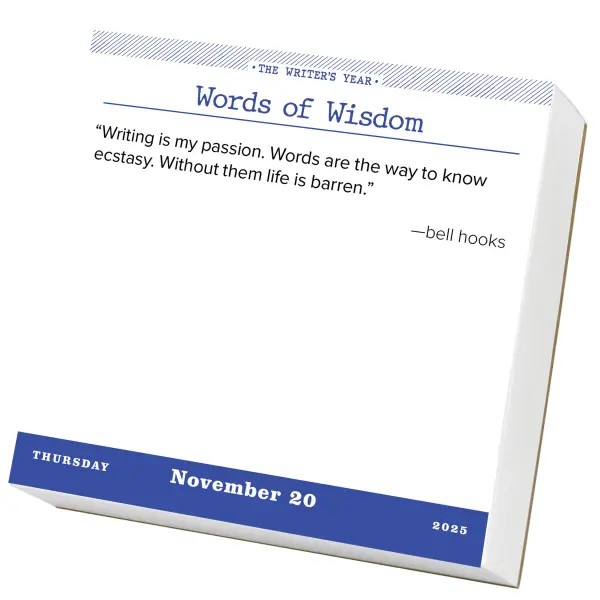
As mentioned a few weeks back, I decided it was time to put all these writing tips and quotes into printed form. Fortunately, the good folks at Workman Publishing agreed. That is why as of this week, you can now get your very own copy of The Writer’s Year: 365 Days of Inspiration, Prompts, and Quotes for 2025.

I’ll repeat what you can find inside, cool stuff like:

  • Illuminating quotes from the greats (James Baldwin, Susan Sontag, Ray Bradbury)
  • Prompts to start your story
  • Recommended reading lists
  • Handy tips on everything from cliches (easy but bad) to rewriting (annoying but good)

It’s at Amazon, Barnes & Noble, Bookshop, and a lot of other fine stores, like those kiosks that sell calendars at the mall during the holidays.

Writer’s Desk: How Do Ordinary Humans Sound?

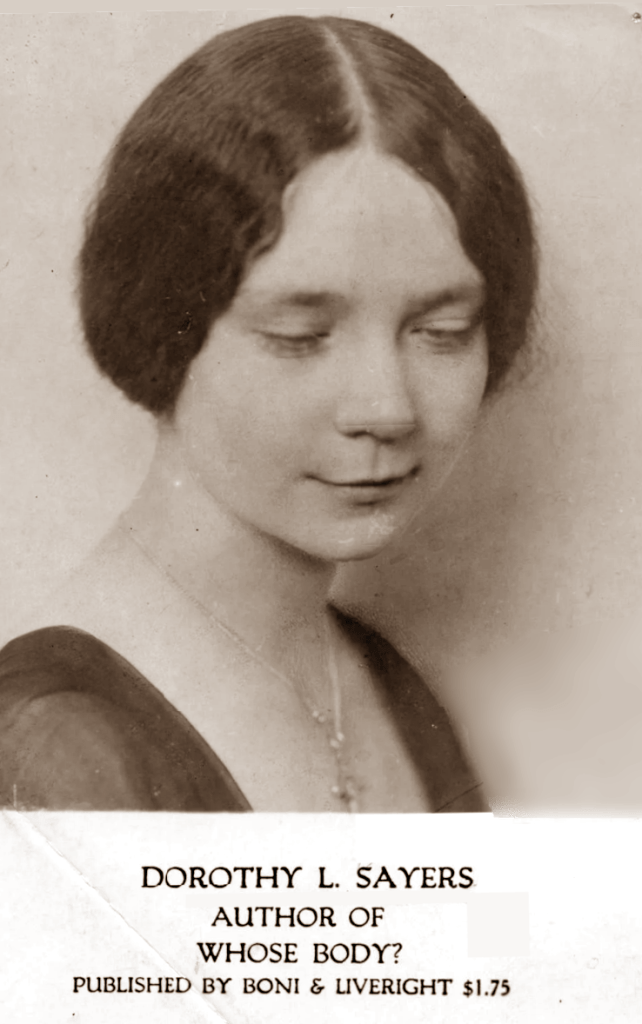
Dorothy L. Sayers, one of the great crime writers, was once asked by a man how she wrote such realistic dialogue between male characters. Did she have a big family or a lot of male friends?

Her answer was to the point:

I replied that I had coped with this difficult problem by making my men talk, as far as possible, like ordinary human beings. This aspect of the matter seemed to surprise the other speaker; he said no more, but took it away to chew it over. One of these days it may quite likely occur to him that women, as well as men, when left to themselves, talk very much like human beings also…

Sayers is being sarcastic, yet also true. Imagine what ordinary people sound like when you hear them speak. Then use that to inspire the sound and style of your dialogue.