New in Theaters: ‘Greedy Lying Bastards’

Greedy-Lying-Bastards_Koch-Industries

greedy-poster

It’s hard to think of a richer subject for these anti-scientific, fear-mongering times. So there was hope that the new documentary Greedy Lying Bastards, which opened yesterday in limited release, would be going for the jugular. Does it? Yes and no.

My full review is at Film Journal International:

As Craig Scott Rosebraugh’s film ably shows, there are many “charlatans” and deniers who make a decent living confusing the issue of climate change, with surprisingly receptive audiences. One of the stranger moments in Greedy Lying Bastards is footage of Tim Philips, president of the oil-industry-funded lobbying group Americans for Prosperity and seemingly just another bland Beltway spokesman in a suit, being greeted at a speaking engagement like a reanimated Elvis. No such excitement will be waiting for Rosebraugh’s film, an earnest but wholly unimpressive bit of advocacy cinema which fails to tap into the dark seam of anger that its title implies…

You can watch the trailer here:


New in Theaters: ‘War Witch’

War Witch

war-witch-posterThere has been plenty written about the tragedy of child soldiers in the African wars, but little that has been put on film that wasn’t a documentary. Kim Nguyen’s blistering, Oscar-nominated War Witch uses the subject as the basis for a haunting, unforgettable film about a lost girl trying to put some kind of a life together.

My full review is at Film Journal International:

In some sub-Saharan African country where wars ebb and flow in a constant, blood-dimmed tide, a teenage girl with the eyes of a traumatized warrior tells the story of how she became a soldier. She wants her child to know what happened, even though she believes her evil deeds are not forgivable. The girl, Komona (Rachel Mwanza), relates everything in a numbed voiceover as though narrating a nightmare. With all its talk of witches and gris-gris and the many ghosts walking around like flesh-and-blood people, War Witch is more like a fairytale from long ago than an of-the-moment topical drama…

War Witch opens in limited release on Friday. Seek it out.

You can see the trailer here:

New in Books: ‘The Dinner’

book-dinner-hermankoch-200 (1)Herman Koch’s nasty surprise novel The Dinner was first published in his native Netherlands back in 2009. Since then, it’s been published in about twenty-five countries and been compared to everything from Gillian Flynn’s Gone Girl to Yasmin Reza’s God of Carnage. The American edition hit shelves this month.

You can read my review at PopMatters:

It begins with blank effect, as though listening to your none-too-interesting friend relate a perfectly ordinary evening filled with ordinary grievances. The narrator, Paul, grouses about this and that, with a chipper flatness that suggests one of those quiet, empty books about ennui and social conventions. Before it’s all over, though, Herman Koch’s serenely malicious little mousetrap of a novel, The Dinner, will have revealed some deadly shadows behind the bright-mannered griping of its opening pages…

Quote of the Day: Churchill on Government

churchill1In 1906, Winston Churchill was a mere Undersecretary of State for the Colonies. By that point, the 32-year-old had already been taken prisoner as a journalist during the Boer War and published four of the books that would later win him the Nobel Prize in Literature.

That year, the future Prime Minister gave a speech in Glasgow where he laid out a philosophy of what liberal government means.

We want to draw a line below which we will not allow persons to live and labor, yet above which they may compete with all the strength of their manhood. We want to have free competition upwards; we decline to allow free competition downwards. We do not want to tear down the structure of science and civilization but to spread a net on the abyss.

It’s an eloquently stated argument, given the current debates over what exactly government is for.

New in Theaters: ‘The Impossible’

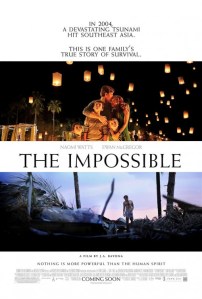
theimpossible-posterIn the based-on-a-true-story melodrama The Impossible, Ewan McGregor and Naomi Watts play a married couple who must fight to survive the aftermath of the 2004 tsunami:

The film flits between the two knots of survivors, contrasting the parents’ heartsick dread of the unknown with their children’s more pragmatic reasoning and straightforward terror. Despite the script’s hacky tendencies the movie repeatedly comes up with devastatingly effective visuals. It underscores how awful it is not to know. At times, particularly in one nerve-rattling sequence where Maria is being flung this way and that by underwater currents, with shadowy objects stabbing out of the murk like vengeful ghosts, it becomes almost unbearable to watch…

The Impossible is playing now in semi-limited release. My full review is at PopMatters.

You can view the trailer here:

New in Theaters: ‘Zero Dark Thirty’

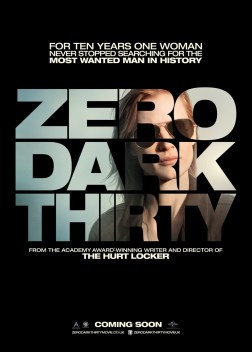
zero-dark-thirty1Between the various Navy SEAL books and films flooding the market, Mark Bowden’s riveting The Finish, and the all the video games crafted around Special Ops strike teams, you’d think commando fatigue would be setting in. Hopefully that won’t be the case once Zero Dark Thirty hits theaters:

Zero Dark Thirty (military jargon for a half-hour after midnight) is an epic take on the Central Intelligence Agency’s hunt for the 9/11 mastermind. Working on a dusty Afghanistan forward operating base, Maya (Jessica Chastain) then shifts to analyzing the intelligence from the American embassy in Islamabad… As the casualties mount and the years tick by, the shell-shocked Maya’s worldview narrows down to a millimeter-wide slit that recognizes only her quarry. The film recounts the agonizingly particular step-by-step analysis of baffling and contradictory information. It just as convincingly relays the sickening sense of urgency in the hunt, a fear that after all the bombings and rhetoric and fear and war, their quarry may simply get away. “We are failing… Bring me people to kill,” seethes Maya’s CIA superior…

Zero Dark Thirty opens in limited release on Wednesday, expanding wider over the several weeks to follow. It’s already been racking up awards from critics’ groups and attracting controversy over its depiction of CIA torture of prisoners; watch for it when the Oscars are announced.

My full review is at Film Journal International.

You can see the trailer here:

Music Break: Rodriguez

The story of Sixto Rodriguez—the Detroit singer-songwriter with the Phil Spector soar to his music and the dark Dylan grit to his lyrics—and how he was rediscovered by a world that was shocked to find out somebody of his talents had lived in the shadows for so long, is one of those rare tales that’s astonishing not just for its oddity but its beauty.

Malik Bendejelloul shot an incredible documentary about Rodriguez, Searching for Sugar Man (much of it using an iPhone with a $1 Super 8 app), that’s well worth seeking out—check out the trailer here.

Ebert was not far off when he wrote:

I hope you’re able to see this film. You deserve to. And yes, it exists because we need for it to.

60 Minutes did a segment on Rodriguez recently (“The Rock Icon Who Didn’t Know It“) that gives you the bare bones of the story.

If you listen to him sing “Sugar Man,” you get some idea of what the fuss is all about and how unfathomable it is that we haven’t been listening to this song on classic-rock radio for the past four decades:

Sight & Sound: Remembering the Lost

For years now, the nearly perfect organization StoryCorps has been traveling the country and giving people the opportunity to just sit down and tell a story about themselves, a friend, family member, or just life. The recordings (which run the gamut from the quotidian to the heartbreaking) are then stored at the Library of Congress, some 40,000 interviews since 2003. It’s an incomparable trove of oral history that will leave future researchers bowing in gratitude.

Their newest project involves putting some of their stories to animation. The result has a This American Life bounciness to them (mostly due to the music), but with a gutsy level of emotion that’s difficult to explain. John and Joe, about one father’s horrendous loss on 9/11 (StoryCorps aims to record at least one interview for each person killed that day), is one of the more memorable short films not just from this program, but from anywhere in recent memory.

You can watch John and Joe here:

One of the other incredibly heartwrenching shorts from StoryCorps’ 9/11 project is Always a Family, watch it here:

New in Theaters: ’17 Girls’

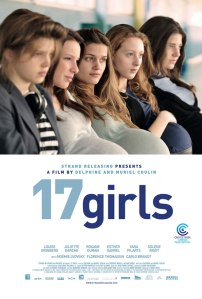
My review of the new French film 17 Girls is running now at PopMatters:

Like any good story about an epidemic, 17 Girls starts with a wholly unremarkable incident. High school student Camille (Louise Grinberg, one of the troublemakers in The Class) finds herself in a family way. But instead of hiding in embarrassment or trying to ignore her swelling belly, she flaunts it. Because Camille is the queen bee, her pregnancy begins to look attractive to her buzzing followers. Within months, bellies begin swelling all over town, and the girls are making plans for what they’re going to do with their babies. Among the things they don’t include in their agenda: not smoking or drinking while pregnant, or considering any of the complications that come with being a single teen mother…

17 Girls is playing now in limited release; make sure to check it out.

The trailer is here:

Dept. of Literary Expatriates: Henry James

Although Henry James remains today one of America’s most celebrated novelists, and his most famous characters were usually American, he was never precisely enamored of his home country. Much like how T. S. Eliot decamped from St. Louis quickly as he could for the more rarefied airs of London intellectual life, James didn’t see much of value in his home country—though, unlike Eliot, he would frequently write as an American abroad in the wider world.

Novelist Colm Toibin, in reviewing Michael Gorra’s new book Portrait of a Novel: Henry James and the Making of an American Masterpiece, pulls out this interesting bit from a piece James wrote about Nathaniel Hawthorne just before The Portrait of a Lady. In it, a sweepingly dismissive James lists the things he sees as missing from American life that he sees as necessary for the novelist:

…no sovereign, no court, no personal loyalty, no aristocracy, no church . . . no palaces, no castles, nor manors, nor old country-houses . . . nor thatched cottages nor ivied ruins; no cathedrals . . . no Oxford . . . no novels, no museums, no pictures, no political society, no sporting class . . . no Epsom nor Ascot.

To a baroque and class-obsessed stylist like James, the country’s comparative lack of history makes for a thin existence. To a degree, James is right, without that weight of civilization which he lists, it is difficult to create a certain kind of literary figure: i.e., those like himself. America did ultimately export the likes of Twain, Hemingway, Kerouac, Bradbury, and Bellow, who all did just fine without thatched cottages or cathedrals—but never could have written The Portrait of a Lady (whether or not that’s a good thing depends on your taste).

New in Theaters: ‘2016: Obama’s America’

Dinesh D’Souza’s documentary makes the case that Barack Obama is a man obsessed with fulfilling the “dream” of his dead father, a staunch anti-colonialist, so much so that he is actively working to degrade America as a world power. While this goal has been camouflaged thus far, the film contends, were Obama to be reelected, his true radicalism would be unleashed. To underline this threat, near its end, the film features a picture of Founding Father Ben Franklin, set aflame…

2016: Obama’s America is playing now in limited release, but is due to expand wider in the coming weeks after a stronger-than-expected opening run. My full review is at PopMatters.

You can see the trailer here:

New in Theaters: ‘Chicken with Plums’


Anybody seeking a well-rounded love story featuring emotionally secure individuals should stay far, far away from Chicken with Plums. Marjane Satrapi and Vincent Paronnaud’s adaptation of Satrapi’s graphic novel focuses on Nasser-Ali (Mathieu Amalric), a violinist living in late 1950s Iran. He plays like an angel, but suffers from an overwhelming moodiness. In the film’s first few scenes, he buys a violin and returns it almost immediately, screaming at the shop owner that he’s been cheated. In fact, life has cheated him…

Chicken with Plums is playing now, and makes for a certain kind of fantastic date movie. My full review is at PopMatters.

The trailer is here: