Writer’s Desk: Follow Your Own Advice

Writers do not lack for advice. They are, in fact, drowning in it. This very site adds another drop to that flood most weeks; hopefully not entirely in vain.

Yes, sage advice from working authors can be crucial to those of us struggling to get words (the right words) on a page each day that do not embarrass us and hopefully put something new and fresh and true out in the world.

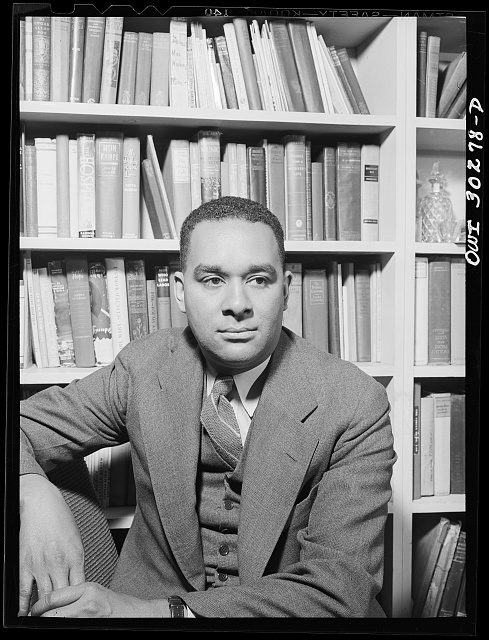
But that will only get you so far. This is what Richard Wright (Native Son) knew.

In 1945, in a letter Wright wrote to the artist Antonio Frasconi, he said:

I hold that, on the last analysis, the artist must bow to the monitor of his imagination, must be led by the sovereignty of his own impressions and perceptions.

You will not get anywhere without listening to what you have to say.

Writer’s Desk: Get the Details Right

In her novel The Mars Room, Rachel Kushner mined the details of her life in San Francisco, specifically growing up on the Pacific side in downmarket Sunset, long before Silicon Valley. Here is how she described it:

The Sunset was San Francisco, proudly, and yet an alternate one to what you might know: it was not about rainbow flags or Beat poetry or steep crooked streets but fog and Irish bars and liquor stores all the way to the Great Highway, where a sea of broken glass glittered along the endless parking strip of Ocean Beach. It was us girls in the back of someone’s primered Charger or Challenger riding those short, but long, forty-eight blocks to the beach, one boy shotgun with a stolen fire extinguisher, flocking people on street corners, randoms blasted white…

Given the litter of specifics there, you can not only imagine the scene but feel Kushner’s tart pride in recalling everything. That same instinct could turn to insult when reading an author who lets their attention slip, doesn’t remember that it was “forty-eight blocks to the beach”.

In Kushner’s essay, “The Hard Crowd,” she writes about her time in Haight-Ashbury, in the detritus of the 1960s, with Oliver Stone shooting The Doors on her doorstep. Sidelining from that, she takes aim at another California-reared scribe, Joan Didion:

In her eponymous “White Album” essay, Joan Didion insists that Jim Morrison’s pants are “black vinyl,” not black leather. Did you notice? She does this at least three times, refers to Jim Morrison’s pants as vinyl.

Kushner then pens an imaginary letter of complaint:

Dear Joan:

Record albums are made out of vinyl. Jim Morrison’s pants were leather, and even a Sacramento débutante, a Berkeley Tri-Delt, should know the difference.

Sincerely,

Rachel

Get those little details right. Get them wrong, and a reader who knows will be instantly pulled out of your writing. Possibly never to return.

Do your research, and keep them coming back for more.

Writer’s Desk: Once Again, With Feeling

A few days after 9/11, Ian McEwan wrote in The Guardian about the aftermath of the tragedy, the shock it had caused in the people he knew. Despite the world-spanning nature of the events, he noted that “the reckoning, of course, was with the personal.”

In describing how people channeled their traumatized watching into fantasies and daydreams that limn the cracks in the “terrible actuality”, McEwan hits on something essential in these imaginings about “what if it was me?”:

This is the nature of empathy, to think oneself into the minds of others. These are the mechanics of compassion … Imagining what it is like to be someone other than yourself is at the core of our humanity. It is the essence of compassion, and it is the beginning of morality.

Your writing does not have to overtly engage with ethical quandaries in order to be moral. All it needs to do is whisk the reader into another person’s consciousness. By doing so, fiction can breed understanding.

Literary Birthday: Zora Neale Hurston

Anthropologist and so-called “Queen” of the Harlem Renaissance Zora Neale Hurston was born today in 1891. She liked giving people varying dates for her birth, invariably ones that marked her as younger. This fooled many writers like Alice Walker, who later helped rescue Hurston’s reputation from obscurity. Hurston most likely crafted this misconception not due to simple vanity but to obscure the fact that she did not even start high school in Florida until 1917, when she was already in her mid-twenties.

Despite such a late start to her education, after Hurston hit New York in 1925, she quickly became a literary star, publishing popular works of autobiography (Dust Tracks on a Road) and autobiographical fiction (Their Eyes Were Watching God) and writing for the Saturday Evening Post.

Writer’s Desk: Art is Not Therapy

Art Spiegelman created some of the greatest literature of the 20th century by translating his and his family’s history into indelible art.

At the same time, he thinks it is more complicated than simply putting one’s thoughts, worries, and pain on the page. As he told Vulture:

Therapy is vomiting things up. Art is about eating your own vomit. There’s a therapeutic aspect to all making, but the nature of working is to compress, condense, and shape stuff, not to just expunge it. It’s not just an exorcism…

There can be nothing braver than coming clean in your writing.

But bravery is just the starting point.

Reader’s Corner: Literary Datebook

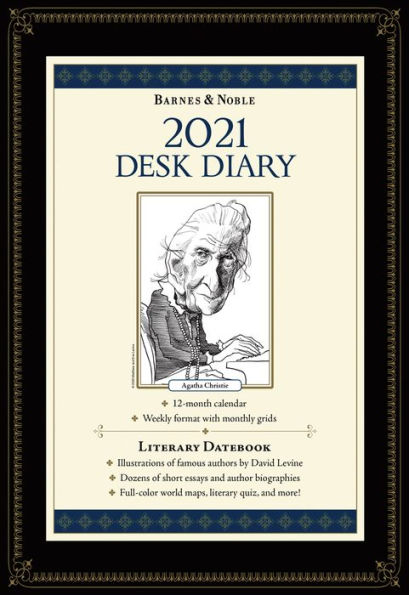
If you are looking for a holiday gift for a literary-minded friend, how about a fancy desk calendar?

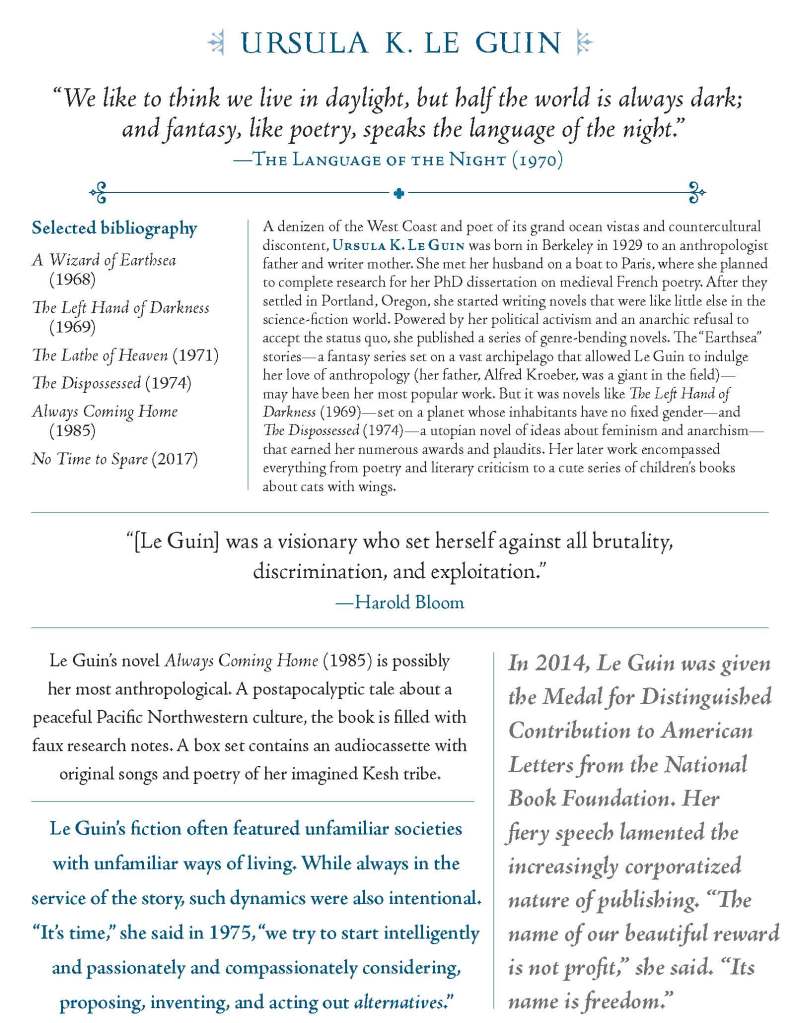
Check out the 2021 Barnes & Noble Desk Diary. Besides being a handsome hardcover edition with David Levine art throughout, it also has a wealth of short pieces about authors written by yours truly tied to the month or year a particular writer was born. There are also some longer profiles, like this one for the great Ursula K. Le Guin:

Get ’em now while they last.

Writer’s Desk: Use Your Memories

In his essay “So What Shall I Write About?” Haruki Murakami talks about his memories as a capacious warehouse filled with odds and ends which he can draw upon for his fiction:

We are─or at least I am─equipped with this expansive mental chest of drawers. Each drawer is packed with memories, or information. There are big drawers and small ones. A few have secret compartments, where information can be hidden. When I am writing, I can open them, extract the material I need and add it to my story…

He goes on to evoke Steven Spielberg’s E.T.:

There’s an umbrella, a floor lamp, pots and pans, a record player … [E.T.] manages to throw all those household items together in such a way that the contraption works well enough to communicate with his home planet thousands of light years away. I got a big kick out of that scene when I saw it in a movie theater, but it strikes me now that putting together a good novel is much the same thing.

Pack your head with memories and ransack them at will. Don’t worry if they do not seem to make sense together at first. They will.

Writer’s Desk: Say It Out Loud. Again.

The great and ever-acerbic Martin Amis has a new book out, Inside Story, which appears to be pretty juicy and part of that popular new sub-genre of quasi-nonfiction “novels”. (He also appears in the great new documentary The Meaning of Hitler which is showing in some festivals now and should be tracked down with all speed.)

Whether he’s expounding on tyrants or the cynical complexities of the London smart set, Amis delivers sharp prose that has reads as though it has been turned over on a lathe until every rough or unfinished particle has been removed. So if he has a bit of advice to provide, it is worth listening to. Here is something he offered at the Chicago Humanities Festival:

Saying the sentence, self-vocalizing it in your head until there’s nothing wrong with it.

If it does not sound right when you say it aloud, it probably will not read right on the page.

Writer’s Desk: Don’t Tell Them Everything

In this interview with the New York Public Library, Pico Iyer explains why it is best for writers to retain some sense of mystery:

Let this book hover somewhere between fiction and nonfiction. Let me give the reader no clue about how to categorize it before she begins or even after she’s finished. Let me put the reader on alert, on edge, not knowing what she’s going to get into.

If your reader has no idea what you are about to do, then everything can be a surprise.

Writer’s Desk: Getting Past the Fear

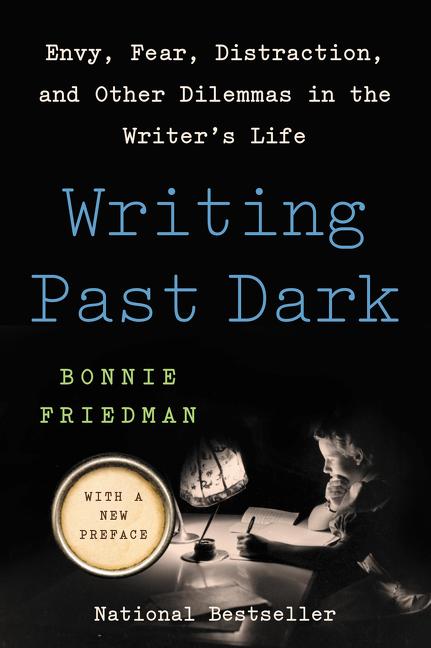
25 years ago, Bonnie Friedman sat down and let all the things that stymied her as a writer just flow out. Her guide, Writing Past Dark, is out now in an anniversary edition.

LitHub talked to Friedman about what led to that book:

There were a lot of things I did that made me suffer as a writer, and I wanted to learn why I did them. For instance, I routinely sickened myself with envy in bookstores. And, I was so afraid of getting right to work in the morning that I did a bunch of chores first and set everything as straight as possible before sitting down, by which point I was tired and there wasn’t enough time left. Also, ambient sounds seemed so interruptive that, even in a frigid Massachusetts winter, I set an air conditioner on my coffee table and turned it on for its enveloping roar. And if a short story received more than two rejections I chucked it forever into a bottom bin, ashamed…

Be proud of your work. It helps.

Writer’s Desk: Be Brave

When Sylvia Plath was attending Smith College in the 1950s and writing furiously in her journals about the kind of life (writing life, to be very specific) that she wanted for herself, she was absolutely determined to better herself. The entries are filled with orders to herself (“I will learn shorthand”, “I will begin reading Joyce”) and plenty of self-criticism.

At the same time, she is also trying to give herself the courage to succeed. Part of that involved trying to overcome her fears. Which appear to be mostly the same as any other writer.

Along the way, she delivers this sharp little apercu:

Everything in life is writable about if you have the outgoing guts to do it, and the imagination to improvise.

The more commonly quoted part comes right after: “The worst enemy to creativity is self-doubt”. While this is certainly true, it does not have the same snap.

Anything can be written about. Just go out and do it. Take from life everything you can for material. But do not be afraid to make up whatever you have to.

Writer’s Desk: Meet a Stranger for Coffee

Like many performers, Maria Bamford is often stricken with insecurities about her own work. That can make it difficult to write, much less perform.

But unlike most writers, Bamford has a unique process for working out her material:

In 2018, she began issuing periodic invitations, on Twitter, for fans who live in cities where she is appearing to meet her for coffee and listen to her run through her set before she performs. 

Is it scary to have a total stranger critique your writing before anybody else in the world sees it? Absolutely.

Is it more scary than having somebody you know critique it? Absolutely not.

If they are willing, talk to strangers about your work. Generally, they’re nice about it.

Writer’s Desk: Say It Clean

In his landmark work From Dawn to Decadence, historian Jacques Barzun has this to say about how the readability of written English can be under threat:

…the resulting obstacles to good prose were: a vocabulary full of technical terms and their jargon imitations, an excess of voguish metaphors, and the preference for long abstract words denoting general ideas, in place of short concrete ones pointing to acts and objects.

When it doubt, say it plain. Simplicity above all.

(h/t: Tablet)

Writer’s Desk: Get Out There and Live

When Walt Whitman first published his genre-redefining verse collection Leaves of Grass, he was not going after small game, acknowledging in the preface:

The land and sea, the animals, fishes, and birds, the sky of heaven and the orbs, the forests, mountains, and rivers, are not small themes…

Not everybody can match Whitman’s cranked-up barbaric yawp approach to writing. But nevertheless, it is worth taking a page or two from his tactic:

Who troubles himself about his ornaments or fluency is lost. This is what you shall do: Love the earth and sun and the animals, despise riches, give alms to every one that asks, stand up for the stupid and crazy, devote your income and labor to others, hate tyrants … read these leaves in the open air every season of every year of your life, re-examine all you have been told at school or church or in any book, dismiss whatever insults your own soul…

Embrace the world. Get out there. Come home. Write about it.

Writer’s Desk: Don’t Give Up

From novelist Yu Hua (To Live, Brothers), one of the great chroniclers of modern China, some advice about perseverance:

I’ve never considered giving up. Before becoming a writer, I was a dentist, spending all my days staring into people’s open mouths. Unhealthy mouths, too – healthy mouths wouldn’t come to the dentist. Maybe there’s a better job than being a writer, but I wouldn’t know. All I know is being a writer is better than being a dentist…

Take it from him. Don’t be a dentist. Write.