Writer’s Desk: Do the Best You Can

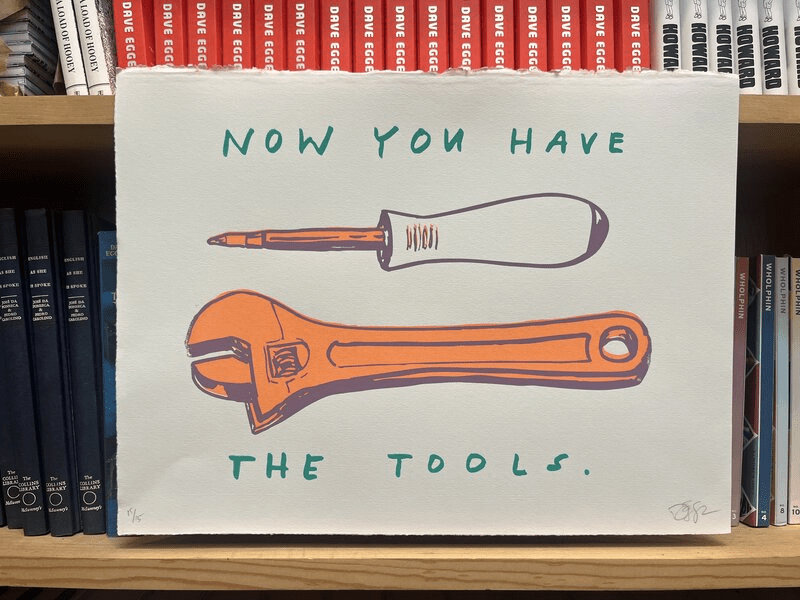
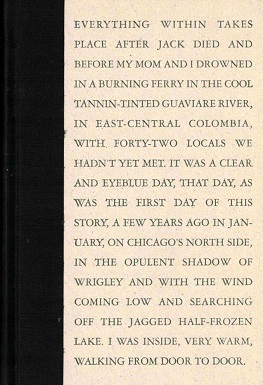
Print by Dave Eggers (McSweeney’s Store)

One of those leading lights of the bookish world, Dave Eggers can always be counted on say the true thing and to identify what matters about this art, business, and life of word making that some of us have committed ourselves to.

Eggers was interviewed by The Harvard Advocate back in 2000, before McSweeney’s really hit its stride and he was still considered an enfant terrible, one of those tongue-in-cheek Gen Xers who wouldn’t know sincerity if it was an ad that came on during The Real World. But in a voluminous reply, Eggers put his cursor on what really makes it all worthwhile:

What matters is that you do good work. What matters is that you produce things that are true and will stand. What matters is that the Flaming Lips’s new album is ravishing and I’ve listened to it a thousand times already, sometimes for days on end, and it enriches me and makes me want to save people. What matters is that it will stand forever, long after any narrow-hearted curmudgeons have forgotten their appearance on goddamn 90210. What matters is not the perception, nor the fashion, not who’s up and who’s down, but what someone has done and if they meant it. What matters is that you want to see and make and do, on as grand a scale as you want, regardless of what the tiny voices of tiny people say…

Make the best book, poem, screed, fan fiction that you can. And if somebody offers you a spot on a teen soap opera, by all means, take it.
Literary Birthday: Dave Eggers

Raised in suburban Chicago, Dave Eggers (born today in 1970) was only 21 years old when his parents died in rapid succession, leaving him to raise his eight-year-old brother, Toph. Eggers moved them to the Bay Area, where he helped found the short-lived Gen-X humor magazine Might and started the longer-lived website Timothy McSweeney’s Quarterly Concern and related McSweeney’s independent publishing imprint.

His part-snarky and part-grief-stricken memoir of that time, A Heartbreaking Work of Staggering Genius (2000), was a Pulitzer Prize-winning critical and audience hit that placed Eggers in the pantheon of other boundary-pushing contemporaries like David Foster Wallace. True to his keenly ironic style, Eggers prefaced his memoir with “Rules and Suggestions for Enjoyment of This Book” (“you might want to skip much of the middle, namely pages 209–301”) and even lays out his major themes (e.g., “The Unspoken Magic of Parental Disappearance,” “The Knowingness About the Book’s Self-consciousness Aspect”), no doubt to the great relief of students assigned the book in a seminar on Postmodern Self-Referentiality in Modern American Biography.

Reader’s Corner: Buy a Book Today

We will lose a lot in these next months. We’ve already lost too much. One thing we don’t need to lose is our independent bookstores. You have watched all the episodes of Norsemen. I’ve watched them twice. Now we need books…

If there were ever a time to take a few extra moments to order through your local bookstore, it’s now. Admittedly, all retail is and will be under unimaginable strain in the coming months, but bookstores are one category where, with owner ingenuity and community spirit, survival might be possible.

— Dave Eggers, “Bookstores Can Be Saved

Writer’s Desk: Put on the Clown Suit

Dave Eggers—who turned 48 last week—once gave a fantastic description of writing fiction:

It feels like driving a car in a clown suit. You’re going somewhere, but you’re in costume, and you’re not really fooling anybody. You’re the guy in costume, and everybody’s supposed to forget that and go along with you.

The best advice in such a situation feels like it has to be: Go with it. Suit up, fool everybody, and plow through until it feels feels absolutely normal.

Reading for 2017

readingroom1

Weekend Reading: December 2, 2016

readingcomic

Reader’s Corner: Best Books of 2013


Best-of lists are particularly absurd when it comes to books, with thousands of titles being released in 2013 alone and easily hundreds of them most likely being worth forking over $25 for. But nevertheless it’s helpful to pull notable ones out of the stacks of new releases; otherwise where would you even get started?

To that end, I published a piece over at PopMatters with short writeups on my 15 favorite books of 2013. It’s a good collection with something for everybody, fantasy to military history, graphic novels to current affairs, Thomas Pynchon to Scientology. You can read it here.

Reader’s Corner: National Book Awards

The finalists were announced last week for the 2012 National Book Awards. The list of fiction finalists overlooked some big-name releases this year from Michael Chabon (Telegraph Avenue) and Tom Wolfe (Back to Blood), not to mention some pulpier (but nevertheless deservedly critically beloved) books like Gillian Flynn’s Gone Girl. The list also drew attention to a couple of novels about the current wars (Billy Flynn’s Long Halftime Walk and The Yellow Birds), which seems appropriate as this is the first year books on that subject have finally started filtering into stores. Here are the five:

  • This is How You Lose Her, by Junot Diaz
  • A Hologram for the King, by Dave Eggers
  • The Round House, by Louise Erdrich
  • Billy Flynn’s Long Halftime Walk, by Ben Fountain
  • The Yellow Birds, by Kevin Powers

It’s a strong list, overall, but the smart money has to be on Diaz to win. Not only has the wait for a new work been excruciating (his astounding novel Brief Wondrous Life of Oscar Wao came out five years ago) but the man just won a MacArthur “genius” grant.

Winners will be announced on November 14, 2012.