Writer’s Corner: Poetry vs. Congress

Pundits who want examples of how America’s school system is failing can easily point to any number of metrics: How the kids are faring in math versus Singapore, or how few of them can locate their own country on a map. One other way might just be to listen to our politicians.

The right honorable Representative Trey Gowdy (R-South Carolina) went on the teevee over the weekend to talk politics. According to the Dumbest Man on the Internet (Missouri’s own!), Gowdy “hit it out of the park.” Judge for yourself:

Well, how would you like to run for reelection if you were in the House and the Senate based on Obamacare with its rising premiums, worse coverage and now we’re trying to convince you that you’re better off writing poetry than you working and getting money?

For those in need of translation from this garbled blather from an elected official, Gowdy thinks that Democrats are telling Americans that it’s better to go write poetry than look for a job. His mangling of the language is bad enough, but his gratuitous slandering of poets is just plain wrong.

As the great Charles Pierce (who memorably identified Gowdy as “a congresscritter from down in the home office of American sedition”) points out, the House of Representatives isn’t precisely known for working these days, unlike poets:

Trey Gowdy, who gets a base salary of $174,000, will work a total of 113 days in formal session this year, in which he will do very little. I happen to know several poets, and I can say with authority that every one of them works harder than does Trey Gowdy, that Philistine meathead, largely because most of them are working two or more jobs, none of which provide benefits.
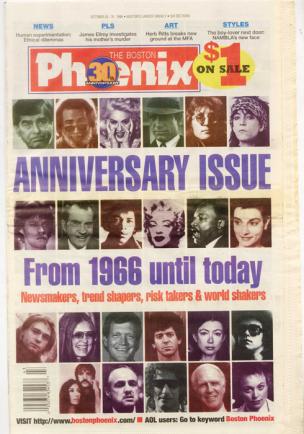
Media Room: Farewell to the ‘Boston Phoenix’

The all-too-common story comes around again: Another venerable institution of print media is going away. After its current issue, the Boston Phoenix is going the way of Saturday mail delivery. For decades, the scrappy alternative paper was an incubator of talent and an actual alternative to what was being reported in the mainstream papers (as compared to the current crop of pseudo-alt-weeklies in most cities, which are often little more than lifestyle-and-listings rags).

bostonphoenix1Like many celebrated papers, the Phoenix had been on the slide for years, hit hard as anyone by the decimation of print media ad dollars, and less able to weather it than their corporate competition. Film critic David Edelstein, who worked there for a few years in the 1980s, wrote that “it was everything I’d ever dreamed of in a place of work —loose, quirky, but with a sense of mission”; but even he admitted to not having read it in years.

The most glowingly emotive recollection came from Charles C. Pierce, currently at Esquire and author of the great Idiot America. He writes in Grantland about his time there in the 1970s and ’80s, when pieces were cranked out in the bar and occasionally you had to write 6,000 words on lobsters.

Between the staff punch-ups, being introduced to Black Flag, and writing whatever was asked for (after all: rent), Pierce recollects what was special about his fellow, Front Page-esque ink-stained wretches:

What’s the prayer of thanksgiving for a hundred days of fellowship, drunk on words, all of us, as though there were nothing more beyond the next word, the next sentence, the next paragraph locked into place? Please say that the muse is something beyond the balance sheet, something beyond technology. Tell me that she’s alive the way she once was when you’d feel her on your shoulder as one word slammed into the other, and the story got itself told, and you came to the end and realized, with wonderment and awe, that the story existed out beyond you, and that it had chosen you, and you were its vehicle, and the grinning muse had the last laugh after all.

Writing for the rent isn’t always a grind; sometimes it’s a benediction.