Writer’s Desk: Stop Complaining

makegoodartNeil Gaiman has no patience for the term “writer’s block.” To him, it smells like a cop-out. Also, according to him, it just doesn’t help:

If you turn around and go, ‘I am blocked,’ this is just something writers say because we’re really clever. It sounds like it has nothing to do with you: ‘I would love to write today, but I am blocked. The gods have done it to me,’ And it’s not true. Cellists don’t have cellist block. Gardeners don’t have gardener’s block. TV hosts do not have have TV host block. But writers have claimed all the blocks, and we think it’s a real thing.

So next time you’re stuck, avoid the term completely. Go for a walk, have another cup of coffee, play with the cats, and then get back to it.

Listen to Neil. He’s written a few things. Many, quite good.

Writer’s Desk: Don’t Write Anything Down

notebook1There are a couple salient moments in this interview with Stephen King. The first is when he gives some counter-intuitive advice about ideas for stories:

I don’t write anything down, any ideas ever, because that’s a good way to immortalize really bad ideas. The bad ideas fall out. It’s a natural Darwinian process. They go away somehow. It’s like throwing a bunch of crackers in a sieve. Some of those ideas shake out because the crumbs get too small, but the big ones stay…

It could make for an interesting experiment. Let the ideas come and if they’re still there by the time you’re ready to put them to page, then those are the keepers. How many of us have gone back to a notebook, looked at a scrawl that seemed amazing at the time, and wondered what the hell we were thinking?

The second memorable quote comes in his response to the interviewer’s question about what is driving King’s current prolific phase: “I’m not as a prolific as I used to be.”

Screening Room: ‘By the Sea’

Angelina Jolie and Brad Pitt in 'By the Sea' (Universal Pictures)
Angelina Jolie and Brad Pitt in ‘By the Sea’ (Universal Pictures)

Set in the 1970s, By the Sea stars Angelina Jolie and Brad Pitt as a couple traveling through France as their relationship nears collapse.

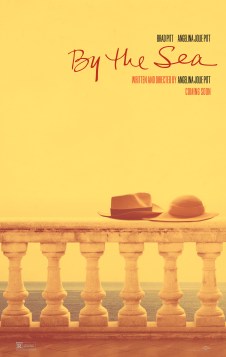
bythesea-posterWritten and directed by Jolie, By the Sea opened this week. My review is at Film Journal International:

A divertingly gorgeous mediocrity, By the Sea arrives onscreen pushing a trainload of expectations ahead of itself. After Angelina Jolie Pitt’s little-seen In the Land of Blood and Honey and last year’s Unbroken, this stands as her first broad test of her abilities as a writer-director. Unlike those war dramas, this chamber piece has no historical resonance or book-club fans to fall back on. There’s just a hotel room, some pretty scenery, and a couple whose marriage is disintegrating. Add to that a stealthy ad campaign, a vague trailer hinting at 1970s Bertolucci-like decadence, and the first pairing of Jolie and her now-husband Brad Pitt since they played another warring couple in Mr. & Mrs. Smith, and you have a movie almost guaranteed to attract all the wrong kinds of attention…

Here’s the trailer:

Writer’s Desk: The American Writers Museum

Sometime in about 2017, there is going to be a new museum on Chicago’s Michigan Avenue right around Lake Street: The American Writers Museum.

According to Publishers Weekly, the project—which sounds both awesome and awesomely quixotic—has been in the works since 2010. Since there won’t be much that a museum of this sort can resort to in terms of permanent holdings (Mark Twain’s pipe, perhaps? Rooms full of first editions?), it looks like they will be focusing on attention-grabbing experiential and interactive exhibits.

writersmuseum1That will mean including things like an interactive “word waterfall.” Which only makes sense, as they will need to bring in the punters in between their Magnificent Mile shopping jag and stroll through Millennium Park. But that will also apparently mean the prospect of interesting-sounding exhibits like the one asking”Are you a Bukowski or Vonnegut?

Hopefully they will include writing workshops and other educational functions as part of the museum’s mission.

Now that it’s happening, it’s curious why this kind of museum is only now being created. Earlier this year, Chicago artist Mia Funk raised this point in an interview with the museum’s president Malcolm O’Hagan (who was initially inspired by the Dublin Writers Museum) in Tin House:

It does seem absurd that America has so many museums devoted to fine art–an activity which really doesn’t touch a lot of people’s lives–but in a country composed of so many immigrants and children of immigrants, where stories have played such a part in remembering our pasts and unifying us, that it has taken us so long to honor our writers collectively.

Here’s hoping they do our writers proud.

Perhaps the most important question, though: What are they going to sell in the bookstore?

Writer’s Desk: Published and Discarded

Book remainders and throwaways are a boon for readers. They lead not just to new discoveries but also access sometimes to desired purchases that are now suddenly available, whether marked down to $5.98 on a bookstore table or sitting out on a Brooklyn stoop for free.

That doesn’t mean that the author has to be happy about witnessing it, as in the cover illustration that graphic novelist Adrian Tomine did for the New Yorker:

newyorkertominecover

Where I live in Brooklyn, there’re always a lot of books being set out on the sidewalk, and there’re also a lot of authors walking around the neighborhood … I’ve had the experience of seeing stacks of New Yorkers with my cover out on the street, though I haven’t seen my books put out—but then, I also don’t have a giant photo of myself on the back cover.

Writer’s Desk: Working in Cafes

cafe1

When the writing den or (for those lucky ones) the separate writing office don’t offer much hope and the walls start closing in, there is always the cafe. The clink and clatter of dishware, the hiss of the espresso maker, the low burble of conversation; for certain kinds of writers this outside interference focuses the imagination more than it distracts.

Per Benjamin Wurgaft in the Los Angeles Review of Books:

Hemingway once reported that in cafés he “was like a charging rhino when he wrote,” noticing nothing but his target. Whether or not this is true, it suggests a familiar kind of authorial self fashioning. For a kid with literary aspirations, to write in cafés is such a cliché that it needs no explanation…

Like anything Hemingway says on writing, this is both utterly true and sheer nonsense. Wurgaft is correct that writing in cafes is a cliche, but for many of us it’s a necessary one. Sometimes just feeling like a writer helps you to become one. And nothing feels more like being a writer than hunching one’s shoulders over a cheap drugstore notebook and knocking out the lines while a coffee of thin brown water (like the Tom Waits line, “the coffee just wasn’t strong enough to defend itself”) goes cold by your elbow…

Writer’s Desk: The Not-So-Solitary Art

writers1

Anybody who knows anything about writing knows about that the gig requires a lot of alone-time. Unless you’re one of those people who can compose lucid prose on a crowded subway train, most writers need to have that space they can get away to in order to put their minds in the right space and put together something that won’t entirely embarrass them.

There is, though, always the problem of the outside world. It intrudes on some writers in the simple matter of making a living. The day job, whether writing-related or not, by definition puts the writer out in the world whether they like it or not. Most writers put up with this because, well, rent.

But these days, it seems like the actual practice of just plain writing, not working to be able to afford to write, has been getting awful social. Part of it is that tic of the modern age where every activity must be shared and turned into an online discussion group. But part of it is simply the business of writing. Attending workshops, participating in panel discussions, even getting up in front of people and teaching a class.

Meghan Tifft laments this turn of events:

History has typically not been generous to the writerly recluse. It’s usually only a lucrative position after the fact of your success—and it works best if you’re a man—Salinger, Pynchon, Faulkner all have that esoteric aura about them that’s quite different from poor old Emily Dickinson, that self-imposed shut-in, or Flannery O’Connor, whose excursive limitations were a sad matter of physical ailment. Even Donna Tartt has to go on 12-city tours. And then there’s me. I’m not Donna, or Emily, or Flannery. I’m not getting anywhere as a young, reclusive, female writer….

So, keep that in mind all you introverts and recluses as you write the Great American Novel. At some point, if you’re lucky, you’ll have to go out there and stand under glaring lights and read your prose to a dozen or so people half paying attention to you over the hiss of the nearby cafe’s espresso machine. It’s a reward, of sorts.

Writer’s Desk: Alone Time

Is there anybody here who can write in a loud room full of people? There are people out there who can somehow accomplish that feat; your average journalist, say, who doesn’t have the luxury of going off to find a cozy tea shop with decent coffee and good Wi-Fi. They’ve got 45 minutes to pound out that 1,100-word piece on the newest unemployment numbers or a listicle on the month’s top 10 most cringe-inducing GOP candidate flubs, and a deadline waits for no man or woman.

Them1Prose is a different matter. Because that’s what we’re generally talking about when we say writing, yes? Those of us who toil on both sides of the fiction divide don’t waste too much time worrying about process and idea-mongering when it’s time to work on the nonfiction material. It’s just as much work, and frequently just as much artistry. But nonfiction writing is simply different. Not to get into fuzzy notions of the muse, but one usually doesn’t need to be struck by inspiration to knock out 500 words on a new misery memoir or 1,500 on what the popularity of Game of Thrones says about the impending collapse of Western hegemony. You just need to find a way in and then how to put all the building blocks together. That’s a vast oversimplification, of course, but it generally holds.

Prose (or verse, assumedly), though, is a creature of a different hue. And it’s not an easy thing to do with others around. Joyce Carol Oates said this to Salon on the question of creativity requiring being alone:

Probably nothing serious or worthwhile can be accomplished without one’s willingness to be alone for sustained periods of time, which is not to say that one must live alone, obsessively. Ultimately, any art is intended for an audience — a community. In this way, the artist/writer is linked to the community and is only temporarily “alone.”

So buckle up, close the door, put on the headphones, whatever you have to do. Don’t worry. The world will still be there when you get back.

Writer’s Desk: Necessary Tools

handmaidstale1People don’t often think about what they need to write. Just a great idea and 10,000 hours, right? They don’t realize that writing requires tools, always. And not the ones that all those websites have been trying to sell you, either.

See what Margaret Atwood has to say:

You most likely need a thesaurus, a rudimentary grammar book, and a grip on reality. This latter means: there’s no free lunch. Writing is work. It’s also gambling. You don’t get a pension plan. Other people can help you a bit, but ­essentially you’re on your own. ­Nobody is making you do this: you chose it, so don’t whine.

Here’s the thing, though. It’s different for every writer. Maybe you’re one of those people born knowing the right word. If so, chuck the thesaurus and move on.

But she’s right about the no-whining thing. Get on with it. Writing still beats doing everything else out there. Except maybe velociraptor wrangler; that’d be cool.

Writer’s Desk: Harper Lee on Who to Ignore

Harper Lee, c. 1962.

There’s a lot of education that can go into being a writer. All those workshops, retreats, seminars, and conferences; there’s enough of them that just taking in a small percentage could be a full-time job.

There’s also the less-formal education, that involves just listening to what other people think of what you’ve done. That’s always necessary, because writing is nothing without its audience.

But it matters who you listen to. Not every opinion matters, after all. Harper Lee knew that. Listen to this, from one of her letters (written after To Kill a Mockingbird was published) that are being auctioned off next week:

…one is not supposed to be aware that critics, reviewers, and English teachers exist.

All those people have their place, of course. But their beliefs should probably only be taken seriously in moderation. Especially by a writer who’s just trying to write.

Writer’s Desk: Good for Nothing

artweek1There’s an old joke about how in Irish families, the boy who can’t throw a ball, well, he’s the priest.

A similar weeding-out procedure is suggested by this line from Rachel Kushner’s brilliant 2013 novel The Flamethrowers:

That’s what artists are, his father said, those who are useless for anything else. That might seem like an insult, he said, but it wasn’t.

So, in other words, run with it.

Writer’s Desk: Going Your Own Way

So, your book is done. Awesome. Now you’ve got to make sure it gets sold. It’s not an easy thing these days, with thinner marketing budgets, digital clamor, and thousands upon thousands of books blooding the marketplace every year. As many authors have discovered, getting your book noticed often falls on their shoulders, even if they were lucky enough to be picked up by a real publisher.

blackmile1Social media marketing helps, among other things. But all that time spent marketing your way takes away from the job at hand: writing. As Jay McGregor writes for Forbes, self-published author Mark Dawson decided to risk doing the thing that is often recommended but is nevertheless hard to do: Give it away. That’s just what he did with The Black Mile, a heavily researched historical thriller.

There was the good news. He “sold” tens of thousand of copies over a weekend.

But:

… he was immediately presented with two problems. The first was that he’d made no money whatsoever from The Black Mile, a book he’d poured hours of research and travel into. The second was that he had no follow-up book for his new fanbase to dig in to.

Now, Dawson is a self-publishing machine, making a living writing, selling, and promoting his work. Of course, a lot of that is possible due to exciting new self-publishing technologies available from a host of companies.

But it still boils down to writing a good book to begin with. You know, the kind of thing that people snap up 50,000 copies of over a weekend. Next, be prolific. Very, very prolific.

Writer’s Desk: But is it a Job?

Thomas Mann; he wrote.

In his essay for the Times on whether or not being a writer is a job or not (as opposed to a calling, hobby, or what have you), Benjamin Moser comes down very firmly on the side of, well, maybe.

He knows what it is: Grueling, exasperating, time-sucking, unavoidable.

He knows what it is not: Easy to define or easy to do.

Then there’s this:

“A writer is someone for whom writing is more difficult than it is for other people,” Thomas Mann said; and it is good that no beginner suspects how torturous writing is, or how little it improves with practice, or how the real rejections come not from editors but from our own awareness of the gap yawning between measly talent and lofty vocation. Fear of that gap destroys writers: through the failure of purpose called writer’s block; through the crutches we use to carry us past it.

It gets easier, of course. For some of us, at least. But easy or hard, there is rarely a choice in the matter. As Moser says, writing is simply what one does. Whether or not it’s a job is in the end irrelevant.

Writer’s Desk: Getting Paid

There are many satisfactions in the writing life; though they all come with caveats. Setting your own hours—unless you’re on deadline. Being your own boss—unless you have to work closely with a narrow-minded editor. And so on.

hereisnewyork1But one of the truest joys that comes with being a writer is when you start to think that you can actually make a living at putting words onto paper.

Longtime New Yorker scribe E.B. White recalled that moment of realization for The Paris Review:

I was twenty-seven or twenty-eight before anything happened that gave me any assurance that I could make a go of writing. I had done a great deal of writing, but I lacked confidence in my ability to put it to good use. I went abroad one summer and on my return to New York found an accumulation of mail at my apartment. I took the letters, unopened, and went to a Childs restaurant on Fourteenth Street, where I ordered dinner and began opening my mail. From one envelope, two or three checks dropped out, from The New Yorker. I suppose they totaled a little under a hundred dollars, but it looked like a fortune to me. I can still remember the feeling that “this was it”—I was a pro at last. It was a good feeling and I enjoyed the meal…

Writing itself is of course a good feeling. Being paid to do so is an acknowledgement from the outside world that you’re not wasting your time doing so.