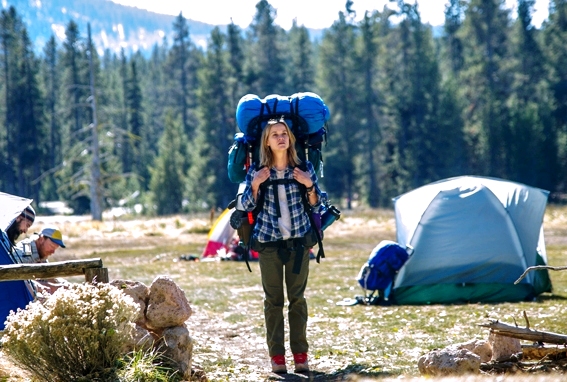
Reese Witherspoon explores the great outdoors and finds herself in ‘Wild’ (Fox Searchlight)
Cheryl Strayed’s 2012 memoir Wild—about her brave and highly foolish decision to hike the Pacific Crest Trail with no training as a way of exorcising her painful past—was many things that a bestseller and Oprah often aren’t: emotionally lacerating, unexpected, vulnerable, and clear-eyed about people’s weaknesses and dark sides. For the inevitable and surprisingly spot-on film adaptation, Reese Witherspoon plays Strayed in what could be an Oscar-worthy performance. That’s Nick Hornby of High Fidelity behind the keyboard.
Wild hits theaters this week. My review is at Film Racket:
Strayed is first spotted on the side of a mountain, pulling a bloody toenail out after days of grueling walking in too-small boots under a groaning pack one could fit the possessions of a small nation-state into. Dropping one boot down the side of the mountain by mistake, she impulsively throws the other boot after it, screaming in rage. Director Jean-Marc Vallee shoots it in all the wrong ways, with slow-motion and elongated vocals, trying to create a drama that the story hasn’t earned yet. It’s a rough start to what is mostly a solidly-crafted and cathartic drama of discovery about a woman who nearly kills herself in order to learn how to live again…
Steve Carell and Channing Tatum in ‘Foxcatcher’ (Sony Pictures Classics)
One of the first films that the smart money says will be a 2014 Oscar contender, Foxcatcher is a stranger-than-fiction true story about a potentially insane man of wealth and his obsession with wrestling in general and a pair of Olympic wrestlers in specific. Given its solid performances from all involved (Mark Ruffalo, Steve Carell, Channing Tatum) and the pedigree of director of Capote and Moneyball, it certainly has a shot at the Oscars; whether or not that’s deserved is another story.
Foxcatcher is opening this week. I reviewed it for Film Racket:
There’s an old joke about how poor people are crazy but the rich are merely eccentric. Bennett Miller’s based-on-a-true-story Foxcatcher vividly illustrates that joke. After all, how many poor people are allowed to own an armored personnel carrier with a .50 caliber machine gun, openly snort cocaine, wave revolvers around, and make documentaries about their pretend achievements, and not be called crazy? John du Pont was the scion of an industrial dynasty with an 800-acre estate and bank vaults full of money. Because of that, he is allowed to follow every controlling desire, even though anybody can see it will end in tragedy. The tautly acted but dramatically deficient Foxcatcher is the story of how a pair of brothers from humble means were pulled into du Pont’s orbit of pathology by the promise of greatness and kept there by the lure of money…
Edward Norton and Michael Keaton square off in ‘Birdman’ (Fox Searchlight Pictures)
In Birdman (The Unexpected Virtue of Ignorance), Michael Keaton plays a onetime action-hero star whose grip on reality becomes a touch, well, fragile after his career falls on hard times and he tries mounting a Broadway play with a hot-shot theater actor (Edward Norton) to prove his relevance.
Birdman opens this week in limited, stoke-the-Oscars release; it’ll go wider around the country later in the fall. My review is at PopMatters:
Part backstage melodrama and part screed in the name of art, Birdman or (The Unexpected Virtue of Ignorance) is nearly as frazzled as its protagonist, Riggan Thomson (Michael Keaton). Back in the pre-Marvel movie era of the ‘90s, Riggan was the winged superhero Birdman. He made three movies that grossed billions and then chucked it all away. And, like many other actors blessed with the role of a lifetime, he is both embarrassed by his legacy and eager to regain its mantle of fame….
The Oscar-nominated ‘August: Osage County’ – #13 of the year’s top 25 films covered in ‘Eyes Wide Open: 2013’
The best approach to take to tonight’s blitzkrieg of hype, blather, nonsense, tears, bad jokes, and long strange stretches of awkward silences—we’re speaking, of course, of the 86th Academy Awards—might be that proffered by Anthony Lane:
Whether Leonardo DiCaprio or Matthew McConaughey, or neither of them, will be crowned Best Actor is a matter of such brazen unimportance that we have gone crazy trying to call it.
Brazen unimportance, indeed. That being said, it was a fantastic year for film. And if it takes a gargantuan mediapocalypse like tonight’s Oscars broadcast to bring attention to some of those films, if sending actors strutting down a red carpet and answering the same questions they’ve been answering for six months now will get another few thousand people to seek out August: Osage County, then so be it.
I covered many of the Oscar-nominated films in this year’s edition of my annual film guide, Eyes Wide Open — it’s available in paperback or more instantaneously in ebook from. Here’s a quick rundown of the Oscar-nominated films included in the book and where they ranked in my lists:
12 Years a Slave (Best Picture, Actor, Actor-supporting, Actress-supporting, Costume Design, Director, Editing, Production Design, Adapted Screenplay) — #2: “Steve McQueen’s blistering adaptation of Solomon Northup’s pre-Civil War memoir about being kidnapped into slavery in Louisiana is memorably horrific and heroic in equal measures.“
Gravity (Best Picture, Actress, Cinematography, Editing, Director, Original Score, Sound Editing Production Design, Sound Mixing, Visual Effects) — #3: “Alfonso Cuaron’s stunning outer-orbit thriller hinges on the parallel between a character’s personal isolation and the terrifying physical isolation of space.”
The Wolf of Wall Street (Best Picture / Actor / Actor-Supporting / Director / Adapted Screenplay) — “An overly slick comedy with painted-on cynicism.”
Inside Llewyn Davis (Best Cinematography / Sound Mixing) — #9: “The Coen brothers are caught between their Barton Fink and O Brother, Where Art Thou? modes in this wintry dream-odyssey of a deadpan comedy swaddled in gorgeous music.”
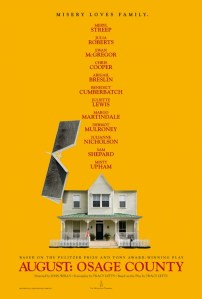
August: Osage County (Actor, Actress) — #13: “A saga of family and dysfunction—cleanly truncated by Tracey Letts from his 3-hour-plus Pulitzer Prize-winning play—whose dark, acid humor never undercuts the recurring tragedy glowering underneath.”
Frozen(Best Animated Feature) — Honorable Mention: “Disney’s impeccably animated return-to-form is both Broadway-ready musical and sweetly inspirational sibling melodrama where for once the choice for the heroine isn’t which man to choose.”
‘Much Ado About Nothing’ – No Oscar nominations but #18 of the year’s top 25 films covered in ‘Eyes Wide Open: 2013’
Lastly, here’s a few of the films most deserving of gold statuettes that were most egregiously overlooked but made it into Eyes Wide Open:
Stories We Tell — #1: “Sarah Polley’s fractured family history is a beautiful and thoughtful story about how our pasts don’t just happen, they’re created.”
Upstream Color — #8: “A metaphysical love story that baffles and excites in almost equal measures.”
Much Ado About Nothing — #18: “Joss Whedon’s minty-fresh adaptation turns his team of quick-witted TV actors on Shakespeare’s most durable comedy and comes up a winner.”
Last word on the Oscars, as often makes sense, to Anthony Lane:
We are already looking forward to looking back in anger at the awards that confounded our hunches, at our loss of the office sweepstake, at the stop-start tears, the sagging jokes, and the normally rational women who choose, for one night only, to dress like exploded cupcakes.
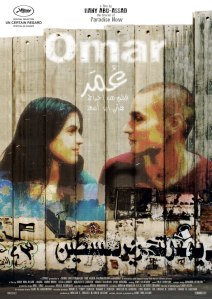
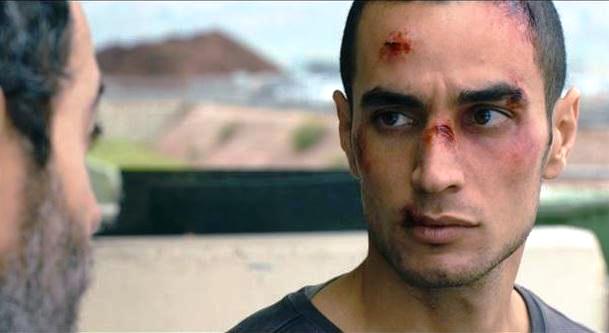
In the Oscar-nominated thriller Omar, a young Palestinian man in the West Bank is faced with two challenges: First, how to convince his friend that he’d be a good bet to marry the friend’s little sister? Second, and more importantly, how does he escape the law after helping to murder an Israeli soldier?
Omar opens this week. My review is at Film Racket:
For such a razor-sharp thriller, the West Bank-set Omar smuggles a dense packet of ambiguity into its compact running time. This shouldn’t be a rarity, given how many stories there are about the conflict between occupiers and occupied, the dueling taxonomy of “freedom fighters” and “terrorists.” But too often these clashes are related in absolutes, where one narrative is bought into more than another. Hany Abu-Assad’s skillful story wrestles with those grey moralities without spoon-feeding one or the other to the audience. It’s a story about people, not ideologies, but it knows how inextricably the former intertwine with the latter…
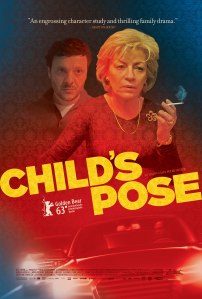
Winner of the Golden Bear at last year’s Berlin Film Festival, Child’s Pose is playing now in limited release, and is worth seeking out. My review is at Film Racket:
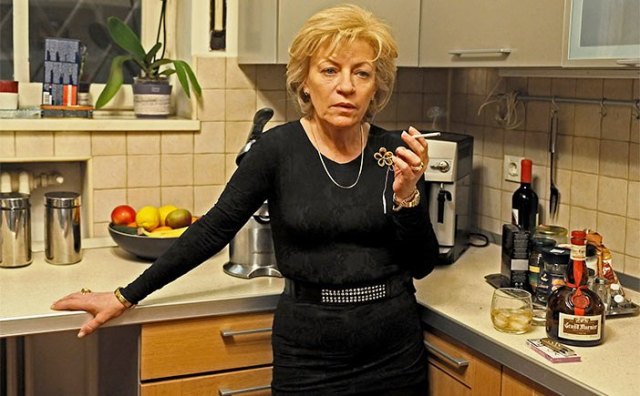
“A mother’s love” has rarely felt more dagger-like or malevolent than in the chilling morality thriller Child’s Pose. Part anatomy of a villain and part crime procedural, Calin Peter Netzer’s film follows what happens after a domineering upper-class Bucharest mother finds out her coddled son has been accused of running down and killing a young boy from the outskirts of town. It’s another in a series of European films (Italy’s The Great Beauty, in particular) that have served as X-rays of societies riddled with corruption like mold veined through a hunk of old cheese. What makes Child’s Pose even more affecting is that many of its characters come off as spiritually corrupt as the society at large. And the rot comes from the top…
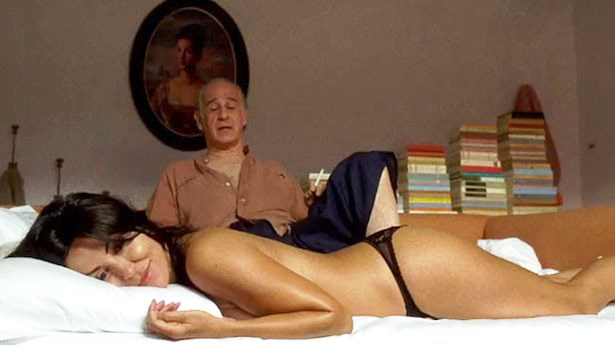
The great Tom Servillo lives it up in ‘The Great Beauty’
Every now and again, a filmmaker is able to conquer the cinematic world with a work that might not have a lot to say (coherently, at least), but it throws enough at the viewer to send them away impressed and a little dazed. Last year’s version of that film was Paolo Sorrentino’s The Great Beauty, a bright and comic variation on Dante’s Inferno that doesn’t hold together in the light of day but seduced enough lovers of Rome and the high life to garner an Oscar nomination.
It’s still playing in arthouses across the land and likely will through the Academy Awards. My review is at PopMatters:
Spectacle is everything in Paolo Sorrentino’s fabulistic Roman candle The Great Beauty (La grande bellezza), and why not? He’s a grand visualist and ringleader of chaos whose talents might remind you of Fellini and Scorsese. Like those directors, however, his films can also suffer for lack of story. It’s almost as though the images come piling up one after another with such rapidity that a framework must be created for them, rather than the other way around. Whatever might have inspired The Great Beauty, it doesn’t come close to sustaining the resulting film. But what a show…
‘Upstream Color’: One of the year’s great movies that didn’t make it onto the Oscar shortlist
Just in time for the upcoming Academy Awards but way too late for the SAG Awards, Golden Globes, and just about every movie awards ceremony that means anything, here comes the newest iteration of my now-annual Best-Of and Worst-Of compilation: Eyes Wide Open 2013: The Year’s 25 Greatest Movies (and 5 Worst).
The title should be basically self-explanatory, but here’s the gist of it: I pulled together what I thought were the 25 best films from 2013—trying best as I could to cover the gamut from the awards magnets that actually deserved the accolades like 12 Years a Slave to lesser-seen fare like Stories We Tell, Upstream Color, and A Touch of Sin. I alsothrew in some other odds and ends like notable DVD reviews, shorter appreciations of great movies that didn’t get into the top 25, great quotes, and of course, the year’s 5 worst films.
2013 was a good year all in all, so the 25 best was much harder to compile than the 5 worst. A nice surprise, for once.
You can buy the book now either in handy-dandy ebook formats here and here. There’s also a paperback edition available here.
With a resume that includes everything from Battleship to Friday Night Lights, Peter Berg isn’t the first guy you would think of to have made one of the modern era’s great combat films. But nevertheless, there he is with a directing and writing credit on Lone Survivor, a tough and emotionally draining film about a doomed Navy SEAL mission in Afghanistan in 2005.
Lone Survivor opens in limited release this week, rolling out more broadly in January. My review is at Film Journal International:
If not for the real-life footage that bookends Peter Berg’s adaptation of Marcus Luttrell’s nonfiction bestseller, Lone Survivor would come close to tipping right into another hero-worshipping chronicle of the special-operations soldiers so beloved by today’s Xbox-playing couch warriors. But the story hasn’t even begun and already Berg has you immersed in images of SEAL trainees getting systematically broken down to the point of tears. Before the choppers rev up and the men fly off into the Afghanistan mountains to go Taliban-hunting, you’ve already witnessed the limits they have been pushed to…
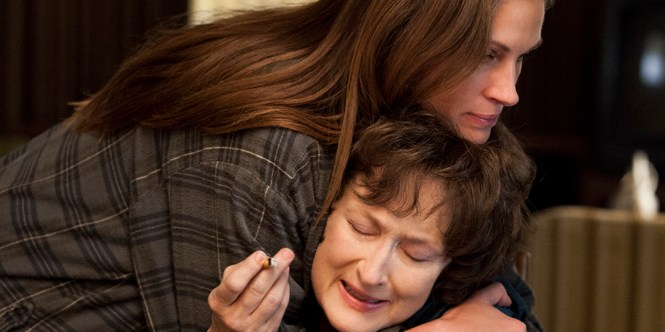
Julianne Nicholson, Meryl Streep, and Julia Roberts in ‘August: Osage County’
Tracey Letts’ play August: Osage County was a sprawling, Eugene O’Neill-esque slab of all-American dysfunctionality that played like gangbusters on the stage. It’s just about the last thing that you would want to see Harvey Weinstein and a pack of Oscar-festooned actors get their hands on; but somehow the truncated film adaptation plays pretty smartly. It opens up the material without lessening too much of the story’s darker impact. Also, Julia Roberts shows up in a Meryl Streep movie and actually leaves a stronger impression.
August: Osage County opened on Christmas Day, go find it! My review is at Film Racket:
This wasn’t supposed to happen. August: Osage County features Meryl Streep lording it over a fractious family as a red-eyed, pill-popping, malicious, cancer-stricken, Eric Clapton-loving matriarch with a black wig that looks a small dog flopped onto her head. But somehow Julia Roberts ends up being the one who sticks with you. She doesn’t do it by trying to reinvent herself. This character is in the same ballpark with the other flinty types Roberts has specialized in over the years. But what makes her stand out from the lesser films that Roberts has wasted most of her time on is her desire to push the limits of unlikeability. During an explosive family dinner scene that violently jerks into a half-thought-out intervention, Barbara Weston (Roberts) turns on her suddenly terrified mother Violet (Streep) like an unleashed animal, bellowing at her and everyone else within a half-mile radius, “I’m in charge now.” It’s more an admission of doom than triumphant declaration…
Here’s the trailer, which makes the film look like some sassy Southern heartwarmer that Roberts would have starred in back in 1996:
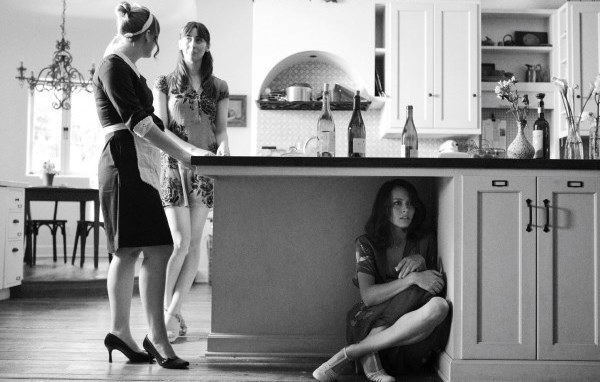
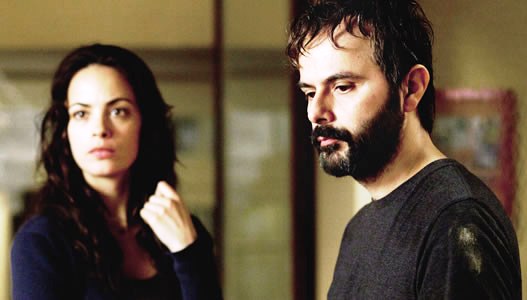
Like the writer said, The past is never dead, it isn’t even past. In Oscar-winner Asghar Farhadi’s newest drama, a French woman (Berenice Bejo, from The Artist) invites her ex-husband back from Iran supposedly to finalize their divorce only to ensnare him in her tangled new relationship.
The Past opened this week in limited release but should roll out around the country over the next couple months. My review is at Film Racket:
Asghar Farhadi’s powerful but unraveled film starts as a domestic drama and then shifts into a mystery. Strangely, the further it pushes the mystery angle, with secrets peeling off like onion skin from the knotted core of the past, the less engaging it becomes. Farhadi’s greatest strengths lie in the parsing of intra-family conflict, where expectations and resentments bubble all around like a musical score. He’s on less sure footing when it comes to building tension by way of soap-operatic revelation. But give the man a husband and wife and a kitchen sitting between them as though it were the battlefield of their lives, and he’s in his element…
Pauline Burlet as the daughter caught between her battling parents in ‘The Past’
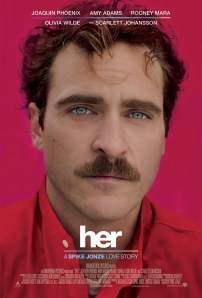
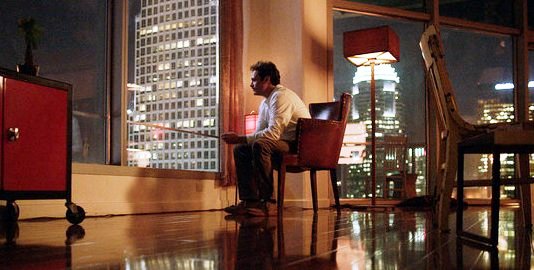
Everyone always says that they just love this phone or that gadget. So it makes sense that Spike Jonze’s visionary but powerfully naive new sci-fi rom-com Her would take that romantic displacement to its ultimate conclusion by having a guy (Joaquin Phoenix) fall in love with his new operating system (voiced by Scarlett Johansson).
In the future, computers will be not only our friends and lovers, they’ll also help us discover our better selves. That seems to be the message of Spike Jonze’s partially genius, often infuriating yuppie sci-fi fantasy about love and meaning in the post-smartphone era. It’s a film that spends so much effort perfecting the sun-dappled look seen in digital-tech commercials, and squinting to see how technology will operate a few years hence, that it doesn’t have much energy left over for its humans. Jonze seems more truly engaged by Samantha, who is the most well-rounded character in the film. Notably, she’s not human…
The Online Film Critics Society, an international group of cinematic scriveners who are kind enough to count me in their number, today announced our awards for the best films of 2013. Not surprisingly, Steve McQueen’s 12 Years a Slave and Alfonso Cuaron’s Gravity took the lead, with five and three wins, respectively, and Cate Blanchett deservedly took another best actress win for her work in Blue Jasmine. Variety reported it here.
Cate Blanchett in ‘Blue Jasmine’
We also gave a special posthumous award to the late, great Roger Ebert, “whose decades of work in criticism helped to popularize serious film appreciation to a wider audience, and whose tireless persistence in the face of cancer was as inspiring as any of the films he championed.”
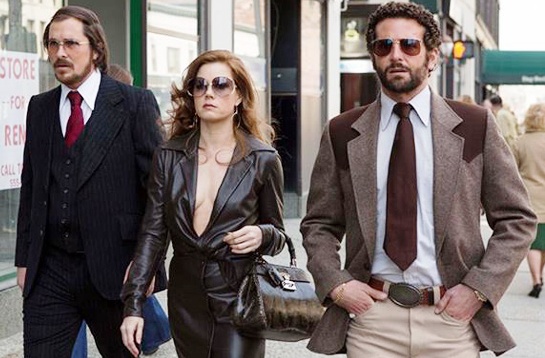
Christian Bale, Amy Adams, and Bradley Cooper strut in ‘American Hustle’
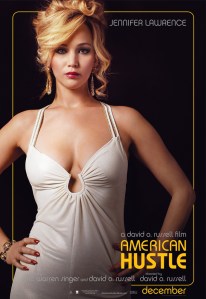
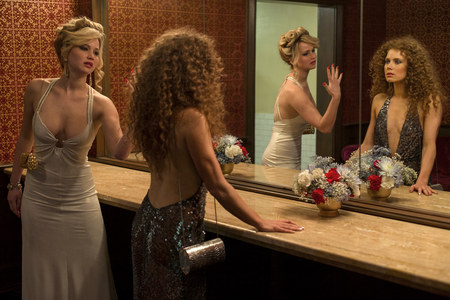
After last year’s wildly popular but kinda underwhelming mental-illness romantic comedy Silver Linings Playbook, David O. Russell changes things up with the sprawling, polyestered, multi-Golden Globe-nominated, 1970s scam flick American Hustle. Not a bad switchup, all things considered
American Hustle opens this weekend in limited release and goes wide on December 20. My review is at Film Racket:
Somehow there’s never been a big movie about Abscam, the ambitious late-1970s FBI corruption probe that convicted six Congressmen and one Senator for taking bribes from fake Arab sheikhs. Although it plays with a few shards of the real story, David O. Russell’s highly imitative but gung-ho drama American Hustle is not really about Abscam. What you have here, amidst all the science-fiction hair and byzantine deals cut in rooms lined with cheap wood paneling, is an epic power ballad of a story about love, friendship, and the high costs of each…
The ladies of ‘American Hustle’
Here’s the trailer, which reveals absolutely nothing about the plot; dig it:
Walt Disney (Tom Hanks) cajoles ‘Mary Poppins’ author P.L. Travers (Emma Thompson) in ‘Saving Mr. Banks’
It’s been a while since Emma Thompson has been a fixture at the Academy Awards; her last win was in 1996 for writing the screenplay of Ang Lee’s Sense and Sensibility. That might change now, with her incomparable work in the new Disney biopic Saving Mr. Banks, where Thompson plays the icy Mary Poppins author P.L. Travers as she gets humbugged by Walt Disney (Tom Hanks), who’s intent on making her astringent fantasy novels into a big, splashy musical.
Saving Mr. Banks opens this weekend in limited release and then wider on December 20. My review is at PopMatters:
One of the great selling points of Saving Mr. Banks is this clash of characters. Travers is the proper British writer representing an already fading ideal of Victorian decorum. Disney is the modern American televisual salesman who has made a career out of ransacking the myths of the world and repackaging them in singing, dancing, animated Technicolor. The practically perfect Thompson is all stiff lip and querulous frown, her Travers wondering what fresh hell she’s just stumbled into; Thompson delivers more information out of a slight narrowing of the eyes than most actors can with an entire speech…

 Cheryl Strayed’s 2012 memoir Wild—about her brave and highly foolish decision to hike the Pacific Crest Trail with no training as a way of exorcising her painful past—was many things that a bestseller and Oprah often aren’t: emotionally lacerating, unexpected, vulnerable, and clear-eyed about people’s weaknesses and dark sides. For the inevitable and surprisingly spot-on film adaptation, Reese Witherspoon plays Strayed in what could be an Oscar-worthy performance. That’s Nick Hornby of High Fidelity behind the keyboard.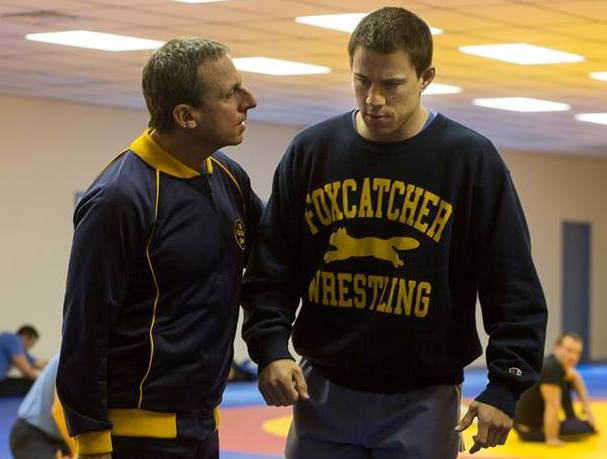








 Like the writer said, The past is never dead, it isn’t even past. In Oscar-winner Asghar Farhadi’s newest drama, a French woman (Berenice Bejo, from The Artist) invites her ex-husband back from Iran supposedly to finalize their divorce only to ensnare him in her tangled new relationship.





 Chris Barsanti
You must be logged in to post a comment.