Tomas Alfredson’s adaptation of Jo Nesbo’s The Snowman, the first of his Harry Hole detective novels to hit the big screen, comes to theaters this weekend.
Deep, deep inside The Snowman, between the permanent rictus of Michael Fassbender’s half-frown and the slow zooms of spooky snowmen, can be glimpsed the outlines of the passable mystery movie that might have been….
“Fair is foul, and foul is fair / Hover through the fog and filthy air” (Weinstein Company)
It’s been awhile since anybody has dared make a film of the Scottish Play. Maybe the curse is finally over? In any case, you could do much worse than Michael Fassbender as the ambitious Thane and Marion Cotillard as the scheming Lady Macbeth.
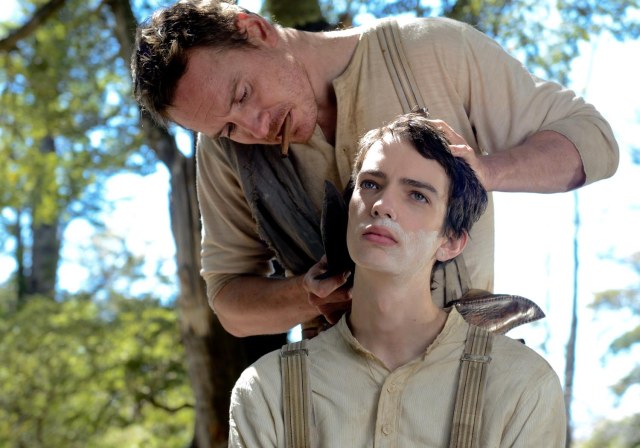
Soaked in foggy Highland gloom, Justin Kurzel’s beautifully dour Macbeth is moody and violent to a fault. Nobody cracks a smile and there’s nary a drop of blood spilled that isn’t captured in slow-motion flight like an outtake from some Ridley Scott medieval sword-fest. That’s all on the page, of course. Nobody would say that the Scottish Play had to be done as comedy. But there’s a reason that some adaptations embed a bitter strain of farce amidst all the plotting, haunting, murder and madness. After all, its protagonists spend a good part of the play completely out of their heads and throwing an entire nation into civil war because of what some witches told them. While their delusions have real-life consequences, to take them entirely seriously is to risk missing at least part of the point…
Indie westerns have blazed and snuck across screens for the past few years in a variety of flavors, from the lo-fi musings of Meek’s Cutoff to the bloody-minded vengeance of The Salvation. But none has been quite as surreptitiously odd and original as John Maclean’sSlow West. There are times when it plays as such a straightforward oater you wouldn’t be surprised to see a craggy Robert Duvall come riding up, Winchester rifle perched casually but authoritatively on his hip. At other moments the story slants sideways to resemble a loonier frontier-mad dream piece like Lisandro Alonso’s Jauja. It never quite stays in reach…
The Online Film Critics Society, an international group of cinematic scriveners who are kind enough to count me in their number, today announced our awards for the best films of 2013. Not surprisingly, Steve McQueen’s 12 Years a Slave and Alfonso Cuaron’s Gravity took the lead, with five and three wins, respectively, and Cate Blanchett deservedly took another best actress win for her work in Blue Jasmine. Variety reported it here.
Cate Blanchett in ‘Blue Jasmine’
We also gave a special posthumous award to the late, great Roger Ebert, “whose decades of work in criticism helped to popularize serious film appreciation to a wider audience, and whose tireless persistence in the face of cancer was as inspiring as any of the films he championed.”
Chiwetel Ejiofor and Michael Fassbender in ’12 Years a Slave’
In 1853, Solomon Northup, a free black man from upstate New York, was freed from the Louisiana plantation where he had been sent twelve years earlier after being kidnapped and sold into slavery. Steve McQueen’s forceful adaptation of Northup’s autobiography is as beautifully detailed and riven with pain as the book.
There are horrors aplenty in Steve McQueen’s blistering, cold-eyed epic of slavery. But amidst the cringe-inducing scenes of torture, McQueen pinpoints acts of cruelty so casual they almost hurt more. The plantation owner’s wife who tells her husband’s newest purchase, a woman just separated from her children, not to worry, “They will soon be forgotten.” Another wife, jealous of her husband’s attraction to a slave woman, raking her fingernails across the woman’s face with no more thought than she’d give to swatting an animal. In a world where people can be treated as property, humanity disappears almost as quickly from the owners as from the owned. The difference is, the owned are trying to hang on to theirs…

 Tomas Alfredson’s adaptation of Jo Nesbo’s The Snowman, the first of his Harry Hole detective novels to hit the big screen, comes to theaters this weekend.


 Chris Barsanti
You must be logged in to post a comment.