Screening Room: ‘I Am Not Your Negro’

iamnotyournegro1

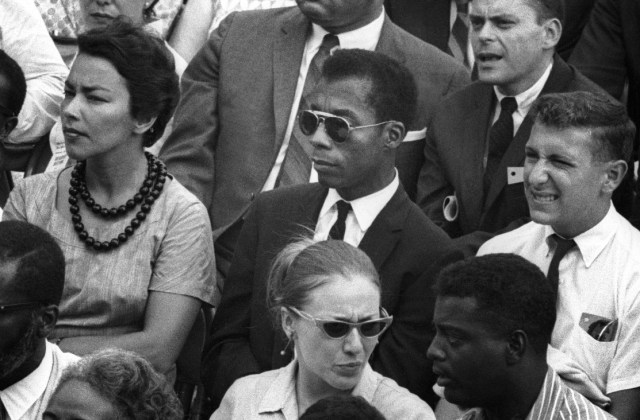
In the 1970s, James Baldwin started working on a book about his three friends who had been martyred for the civil rights cause: Medgar Evers, Malcolm X, and Martin Luther King, Jr. The book was never finished. The spectacular and burningly relevant new documentary, I Am Not Your Negro, threads the pieces of that elegy through a skein of dramatic footage.

I Am Not Your Negro is opening this weekin limited release, followed by a full roll-out in February. My review is at PopMatters:

An elliptical film, I Am Not Your Negro is partially a history of the Civil Rights struggle from 1955 to 1968, framed by these three men. It’s also an unpacking of Baldwin’s take on white America’s inability to come to terms with race and racism, with which it remains obsessed but also, of which it remains ignorant. There is anger aplenty in the film, but Baldwin’s observations indicate the confusion that might be inevitable in trying to understand the “vast, unthinking cruel white majority”…

The trailer is here.
Screening Room: ‘Bobby Sands: 66 Days’

bobby_sands_66_days

Bobby Sands: 66 Days is a sharp new documentary about the IRA hero’s world-gripping 1981 hunger strike and how it encapsulated the feverish passions of the Protestant-Catholic “Troubles.”

It’s playing now in limited release. My review is at Film Journal International:

Northern Ireland was still convulsing after years of strife. As Byrne’s dense weave of televisual archive footage shows, the form of battle ranged from peaceful marches to assassinations and running street skirmishes pitting gangs of rock- and Molotov cocktail-armed Catholic youth against British soldiers and a primarily Protestant police force. But for a few details, the footage of a city in free-fall could have been shot anywhere from Berlin circa 1945 to Aleppo today: children playing in burnt-out cars and rubble-strewn fields, the few standing walls covered in political graffiti…

Here’s the trailer:

Screening Room: ‘Best Worst Thing That Ever Could Have Happened’

bestworstthing1

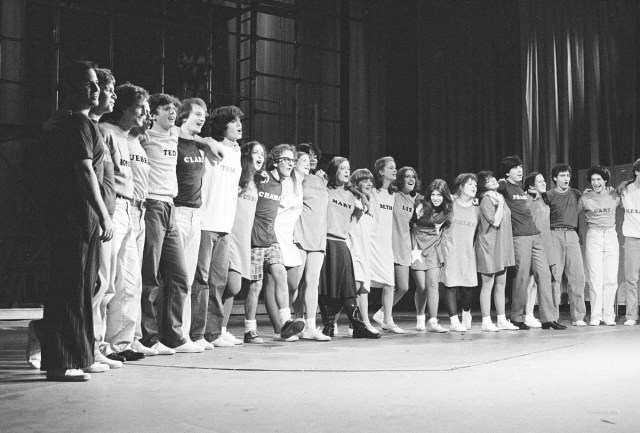
In 1981, Stephen Sondheim and Hal Prince were the kings of Broadway. After a decade of shows from Company to Sweeney Todd that reinvented the American musical form, they were embarking on another venture: Merrily We Roll Along. Things didn’t go as planned.

Directed by Lonny Price, one of the original cast members, Best Worst Thing That Ever Could Have Happened is the up-close account of one of Broadway’s most infamous flops. It’s opening this week in limited release and will probably show up on PBS soon. My review from the New York Film Festival is at PopMatters:

At first, Price makes Best Worst Thing That Ever Could Have Happened something of a personal essay, describing with enthusiastic panache his obsessive love of the form in general and these practitioners in specific. Then he broadens the circle, marrying rehearsal footage of other cast members like Tonya Pinkins and Jason Alexander (eight years before he won a Tony and nine before appearing in Seinfeld) with new interviews. One actor remembers, “You felt like you were witnessing history.” That about sums up the type of enthusiasm that Price delivers here…

Here’s the trailer:

Screening Room: ‘All Governments Lie’

Yallgovernmentslie1ou would imagine from the title of the new documentary All Governments Lie, that it’s an investigation of, well, government corruption. But that’s only a sideline in this barn-burner about corporate media’s apparent inability to hold those lying politicians to account.

All Governments Lie is playing now in limited release. My review is at Film Journal International:

If you take everything in Fred Peabody’s screed All Governments Lie: Truth, Deception, and the Spirit of I.F. Stone at face value, then you might as well cancel your New York Times subscription. Don’t read the Washington Post either. PBS’ “Frontline” and CBS’ “60 Minutes”? Garbage, the lot of them! That’s the takeaway from this narrowcast documentary, which takes a valid critique of the deadening effect corporate-government synergy can have on mainstream media’s ability to truly afflict the comfortable and comfort the afflicted and undercuts it with poor logic and simplistic argument…

Screening Room: ‘Command and Control’

command-and-control1

Getting a brief theatrical run before its PBS debut, one assumes to qualify for the Oscars, Robert Kenner’s adaptation of Eric Schlosser’s book Command and Control is a bracing documentary about a nearly forgotten threat: America’s sprawling nuclear arsenal.

Command and Control is opening this week in limited release. My review is at Film Journal International:

The post-9/11 adage about how security services have to be right all the time while terrorists only have to be right once could easily be adapted to Robert Kenner’s vivid new documentary: People who work with nuclear weapons only have to make one mistake for everything to go to hell…

Here’s the trailer:

Screening Room: ‘Defying the Nazis’

sharpswar1

On the brink of World War II, a Unitarian minister and his wife were ordered by their community to travel from Massachusetts to Europe with a crucial mission: Help as many refugees escape as you can.

Defying the Nazis: The Sharps’ War, which was co-directed by Ken Burns, is opening this week in limited release. It will be broadcast on PBS September 20. My review is at Film Journal International:

Ringing with a vivid moral clarity, Defying the Nazis: The Sharps’ War is a tightly focused documentary that raises an unusually sprawling number of challenging questions for its audience. Unlike many stories of this kind, the film doesn’t pretend that the choices made by its undeniably brave subjects were easy ones or that a cost wasn’t required for their decision to go willingly into the horrors of Nazi-occupied Europe to save whoever they could…

Here is the trailer:

Screening Room: ‘The Lost Arcade’

lost_arcade-1465404120-726x388

For years, the last arcade in New York was a gritty little spot called the Chinatown Fair. There, night after night, gamers gathered to compete, play, gossip, and boast until the early hours. Then it closed.

The Lost Arcade has been playing the festival circuit. It opens at the Metrograph in New York this week. My review is at Film Journal International:

Everything about the videogame palaces in The Lost Arcade makes them look like oases. Shot mostly at night, because that’s when the gamers come out, the arcades blaze into the darkness with their teenage-Vegas cacophony of strobing lights, electronic bleeps, and the hoots and hollers of victors and vanquished. Clearly, these are not just places to drop some quarters and kill a half-hour on the latest Street Fighter; they are clubhouses, homes away from home…

Here’s the trailer:

Screening Room: ‘Richard Linklater – Dream is Destiny’

Julie Delpy and Ethan Hawke in Linklater's 'Before Midnight' (2013)
Julie Delpy and Ethan Hawke in Linklater’s ‘Before Midnight’ (2013)

In 1991, Richard Linklater helped blow open the American indie filmmaking scene with Slacker, his rambling odyssey of drifters and dreamers on the edge in Austin, Texas. Since then, he’s made everything from high school party films (Dazed and Confused) to modern romances (the Before trilogy).

Richard Linklater – Dream is Destiny opens this week in limited release. My review is at Film Journal International:

It almost seems wrong to use the word auteur when talking about Richard Linklater, especially after seeing this friendly and appreciative survey of his life’s work. As unique and idiosyncratic as Linklater’s body of work is, there remains a modesty to it that carries over into the person who appears onscreen. Unlike in many documentaries about great directors or other artists, co-directors Louis Black and Karen Bernstein hardly stand back in awe from their subject, they sidle right up next to the unassuming artist and simply ask him how he does it. “It’s a lot of hard work,” says the director of Slacker, Boyhood, and other touchstones of the American independent film movement. “And people don’t want to hear that”…

Here is the trailer:

Screening Room: ‘Zero Days’

zero days2

With all the news the last few days about not just the thousands of emails stolen from the Democratic National Committee but the possibility that the hack was directed by a foreign power (and a certain presidential candidate’s request that that power do yet more hacking), the as-yet mostly theoretical idea of cyberwar has suddenly hit the mainstream.

zero days-posterIn a rare convergence, Alex Gibney’s prescient documentary Zero Days hit theaters just a couple weeks ago. My article, “DNC Hack Could Make Zero Days the Year’s Most Prescient Film,” is at Eyes Wide Open:

Zero Days does not directly relate to the kind of offensive cyber operation that is alleged to have happened with the DNC. However, in his deep-undercover, whistleblower-thick narrative, Gibney does paint a picture of the types of motives and capabilities that directly relate to what is potentially happening now. It serves as a kind of road map for the new geopolitical battleground that many of us might have just gotten a glimpse of in this sweltering summer of unease…

Here’s the trailer:

Screening Room: ‘T-Rex’

t_rex-01

As if growing up poor in Flint, Michigan wasn’t difficult enough, Claressa “T-Rex” Shields decided to set herself a lofty goal: Becoming the first woman to win a gold medal in boxing at the Olympics.

Shields’s awesomely gripping story is the subject of T-Rex, which is playing now in limited release and should show up on PBS in the next year. My review is at Film Journal International:

Outgoing but tough and pragmatic, Shields is blunt about how she got started at the gym she’s been boxing at since age eleven: “I was just down here, beating guys… It was something I liked to do”…

Here’s the trailer:

Screening Room: ‘Hooligan Sparrow’

hooligan-sparrow1

This year’s Human Rights Watch Festival opens with a strong indictment of the institutional and moral corruption of modern-day China, as laid bare by a tiny insurgent band of determined women activists.

My review of Hooligan Sparrow, whose footage had to be smuggled out of China and which opens the festival this Friday in New York, is at Little While Lies.

Here’s the trailer:

Screening Room: ‘The Witness’

thewitness2

When 28-year-old Kitty Genovese was raped and murdered while walking home in Kew Gardens, Queens one night in 1964, the story spread that many of her neighbors heard the assault take place but did nothing to stop it. 

Her case became a totemic story of the apparent moral lassitude spreading across the country. James Solomon’s documentary about Genovese opens the case back up, to see what really happened.

The Witness is opening this week in limited release. My review is at Film Journal International.

Screening Room: ‘How to Let Go of the World…’

howtoletgooftheworld1

The new environmental documentary from Josh Fox (Gasland) starts off as a terrifying plunge into what climate change will be doing to the Earth, and the human race, over the next few decades. But then Fox does something unusual: He tries to find what there is to be happy about in all this terrifying prognostication.

How to Let Go of the World and Love All the Things Climate Can’t Change is playing now in limited release. My review is at Film Journal International:

Josh Fox’s first two films—Gasland and Gasland Part II—were micro-targeted issue documentaries about the environmental dangers of fracking for natural gas, particularly near his home in upstate New York. So it makes sense that his newest film, How to Let Go of the World and Love All the Things Climate Can’t Change, would start off in the same vein. He opens on a shot of him dancing with a charming lack of rhythm to the Beatles’ “Ob-La-Di, Ob-La-Da.” It’s a way of celebrating the rare victory: After years of activism, fracking was outlawed in the Delaware River watershed…

Here’s the trailer:

Rewind: The Real Anita Hill Story

anita-poster1Tonight, HBO is premiering Confirmation, their fictional take on the Clarence Thomas Supreme Court confirmation hearings in 1991. It was the first of the decades televised scandal melodramas, not least for the spectacle of the Senate’s hostile grilling of Anita Hill about her accusations of sexual harassment by Thomas.

Freida Lee Mock’s documentary Anita (2014) is an instructive take on Hill’s experience under the spotlight and how the resulting controversy changed the country.

My review is at Film Racket.

Here’s the trailer:

Screening Room: ‘Vaxxed,’ Film Fests, and Truth

Tribeca2016.jpg

The Tribeca Film Festival, which has long been one of the country’s premier venues for new documentaries, ran into controversy recently when they pulled one of their films from the schedule. Vaxxed: From Coverup to Catastrophe is a documentary by Andrew Wakefield, one of the top pushers of the vaccines-cause-autism conspiracy theory. Not surprisingly, some people had a problem with this.

My article “Why the Tribeca Film Festival was Right to Pull Vaxxed‘ ran in the online edition of Little White Lies:

The argument to screen Vaxxed regardless of its relationship to the truth feels similar to that pushed by creationists who cloak their school agendas under the cloak of “teaching the controversy,” when in fact no actual controversy exists…