One more note on the late, great Philip Seymour Hoffman. Back in 2004, he was interviewed by The Believer and the talk sprawled over beyond life and acting into things literary.
Hoffman has played a few great figures from both sides of the literary page (Willy Loman, Truman Capote), but that’s not what gave him the credentials for this interview, it’s that he was clearly a passionate reader. Not a lot people out there these days who will stand up and shout for the dark glories of somebody like Richard Yates:
If you do any great art you’re somehow exposing a part of you. Like Richard Yates, Jesus Christ, that book, you almost don’t want to meet him. I kept feeling for the characters as if they existed.
But perhaps most beautifully, he identifies one of the great solaces of reading, that it’s an act in and of itself with no need to be justified. Some won’t care for his comparing it to smoking, but the linkage is clear:
When you read, you think, and when you smoke, you think. It’s a pleasurable thing, and not a duty.
Philip Seymour Hoffman was a bandit of an actor. From The Talented Mr. Ripley to Charlie Wilson’s War and The Ides of March, he was rarely better than when committing full-scale larceny on the screen—walking away with an entire film while leaving A-list actors stumbling about in his wake.
With such a rich body of work cut so horrendously short, you would think it would be hard to zoom in on one particular performance that summed up his appeal. But it’s not. Almost every writer who saw Cameron Crowe’s Almost Famous still remembers the scene when Hoffman, as stupendously self-destructive rock writer Lester Bangs, advises the film’s adolescent wannabe scribe about remaining true to the art and not giving in to the temptations of flattery and cool.
A few lines are thrown into the lonely night (“good lookin’ people, they got no spine…their art never lasts”) and Hoffman creates a brotherhood of uncool with his awe-inspiring mix of gruff attitude and aching vulnerability:
The only true currency in this bankrupt world is what you share with someone else when you’re uncool.
The writing is Crowe’s but Hoffman makes it immortal:
Once upon a time you could safely rely on being able to find a couple things somewhere on TV, if you just flipped around long enough: The Three Stooges and the old Batman series. Running in seemingly near-constant syndication long after its too-brief run (120 episodes over 3 seasons from 1966–68), its Pop Art-mad cheeky humor was the way that most people growing up in the 1970s was introduced to the Caped Crusader. Once Frank Miller and Tim Burton started going all gothic on Bruce Wayne in the ’80s, it was always characterized as a reaction to the camp factor of an Adam West Batman and villains like Liberace, Tallulah Bankhead, and Milton Berle.
But the show has been increasingly hard to find outside of YouTube and black-market dubs, due to a long-running rights dispute. That may soon be over, as it was reported yesterday that the entire run of the series will be released in a box set of DVDs and Blu-ray sometime later this year. The news was broken by … Conan O’Brien. Big fan?
Still trying to figure out how to finish that first part of a six-part series of zombie CSI novels, or maybe you need time to work on your epic poem cycle about climate change? Working the job and paying rent can definitely take time away from time spent with your laptop or quill.
Well, worry no more, because there’s a new nonprofit organization called WriteAHouse that wants to give away houses in Detroit to writers. That’s correct: Free house to write in.
If approved, writers are expected to:
commit to living and writing in the house for two years
pay insurance and property tax
finish renovating the house (it’ll be 80% inhabitable at time of moving in)
regularly contribute to the WAH blog
“participate in local readings and other cultural events”
Then, after two years, the writer is given the deed to the house. That’s pretty much it. Nice job thinking outside the box, Detroit.
Legend has it that after Vincent Van Gogh saw Rembrandt’s painting The Jewish Bride in Amsterdam—where it still hangs today in the renovated Rijksmuseum—he said this:
I should be happy to give 10 years of my life if I could go on sitting here in front of this picture for a fortnight, with only a crust of dry bread for food.
The math there might be a little on the extreme side (Van Gogh wasn’t one for half-measures, after all), but still, who wouldn’t say something like that about some work of art? The novel that you read at twelve years old which opened your eyes to the world, the painting that made you think “So that’s why people come to museums,” the song that you cry upon hearing whether it’s the first or the hundredth time? How much would you sacrifice to be allowed more time with your favorite book?
The ultimate success of the late Lou Reed (1942–2013) as a musician and writer was, like with most great artists, never a sure thing. Although he went from obscurity to rock legend in a few short years, he started out pushing an idiosyncratic style of literary talk-singing and mixing old doo-wop harmonies with discordant sheets of noise that was never guaranteed to win him entry to the Rock and Roll Hall of Fame. Nevertheless, he put his whole life into it: “My God is rock ‘n’ roll,” he supposedly said.
For an example of how the music of Reed’s early years was received, check out this notice from the New York Times in 1966. The story was a society piece about a dinner for the New York Society for Clinical Psychiatry. The evenings entertainment? Something called “The Chic Mystique of Andy Warhol.” On the program was the Velvet Underground:
The high decibel sound, aptly described by Dr. Campbell as “a short-lived torture of cacophony,” was a combination of rock ‘n’ roll and Egyptian belly-dance music.
Most guests voted with their feet and streamed out early. Reed and the Velvet Underground were inducted into the Rock and Roll Hall of Fame in 1996, Egyptian belly-dance music (did they play “Venus in Furs,” perhaps?) be damned.
Here’s Reed performing one of his best post-Velvet songs, “Halloween Parade”:
Is it possible that to learn how to write something grand you should also practice penning something so abominably wretched it should never see the light of day? Probably not, the art of writing probably comes down to something as dreary as trying every single day to hone your craft to a sharp, chisel-like point.
So, if you were going to attempt to write horrendous prose, there’s really no other reason to do it except for a giggle. Because, after all, as more than one person has noted, somebody already wrote 50 Shades of Grey. So anything you do will be at best, second-worst writing ever.
Herewith one of the many preternaturally horrible opening lines culled from submissions to the Bulwer-Lytton Prize:
When Mr Bilbo Baggins of Bag End announced that he would shortly be celebrating his eleventy-first birthday, his children packed his bags and drove him to Golden Pastures retirement complex just off Interstate 95.
Also:
It was such a beautiful night; the bright moonlight illuminated the sky, the thick clouds floated leisurely by just above the silhouette of tall, majestic trees, and I was viewing it all from the front row seat of the bullet hole in my car trunk.
And, a personal favorite:
The professor looked down at his new young lover, who rested fitfully, lashed as she was with duct tape to the side of his stolen hovercraft, her head lolling gently in the breeze, and as they soared over the buildings of downtown St. Paul to his secret lair he mused that she was much like a sweet ripe juicy peach, except for her not being a fuzzy three-inch sphere produced by a tree with pink blossoms and that she had internal organs and could talk.
It’s that time of year when attentions get torn between the World Series and the ever-growing all-encompassing athletic-entertainment complex that is football. Being that the latter has almost definitely overtaken the former as America’s game, there’s no end to commentary and opinion about the gridiron spectacle.
One of the month’s more intriguing notes on football, though, comes from an unexpected source: Donna Tartt’s new novel, The Goldfinch. Here’s a short excerpt (noted by James Wood in the New Yorker) in which the narrator is talking about the ritual of watching Sunday football games out in Las Vegas:
On game day, until five o’clock or so, the white desert light held off the essential Sunday gloom — autumn sinking into winter, loneliness of October dusk with school the next day — but there was always a long still moment toward the end of those football afternoons where the mood of the crowd turned and everything grew desolate and uncertain, onscreen and off, the sheet-metal glare off the patio glass fading to gold and then gray, long shadow and night falling into desert stillness, a sadness I couldn’t shake off, a sense of silent people filing toward the stadium exits and cold rain falling in college towns back east…
Never mind that college games happen on Saturday for the most part; you still have here a beautifully gloomy little snapshot of that autumnal bleakness that always seems to hover around the game.
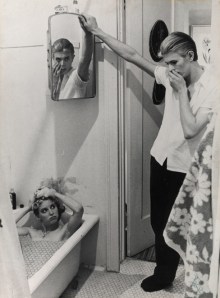
Yes, even rock stars read. One of the lesser appreciated elements of the hit exhibition “David Bowie Is” — running now at the Art Gallery of Ontario after a smash run at London’s Victoria & Albert Museum — was its inclusion of the Thin White Duke’s reading list.
Bowie’s Top 100 books is really just a smashing collection. He hits many of the cool-minded modernist writings of the 20th century, from T.S. Eliot to Yukio Mishima and John Cage, as well as a heavy stocking of music-oriented books.
But there’s some great newer choices in here as well, from Junot Diaz to Michael Chabon, and some agitprop from Howard Zinn and Christopher Hitchens.
It doesn’t quite make sense that there’s no William S. Burroughs here, given how influential the old man’s work was on Bowie’s early polymorphous phase. But maybe Naked Lunch or Junky made Bowie’s Top 200 list…
Tommy Stinson (left) and Paul Westerberg bring the rock
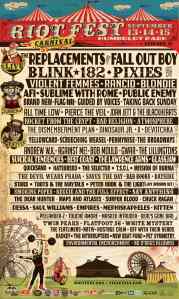
Last month, Chicago’s Riotfest — a three-day hootenanny already highlighted by great sets from The Selecter, the Violent Femmes, and many others — presented the return of the Replacements. Well, Paul Westerberg and Tommy Stinson, at least. In short, it was everything you could have hoped for, a mere 22 years after they broke up.
A few minutes after the Pixies finished up a listless, Kim Deal-less set nearby, the Replacements stormed the stage. They cranked into their set like they were already a half-dozen shows into their latest tour, not like a group of guys who had only previously played together at Riot Fest Toronto in late August. That’s to say, things were a little raggedy at times, but only in the way that an outfit both tightly coiled and explosively loose-limbed like this could pull off.
Paul sported bright red short pants, a spiky jumble of hair, and a snarling smile that made him look like some moonlighting circus performer who hadn’t quite left his day job behind. There was no preamble to mop up the grateful applause from the gathered throng. They just slammed right into things…
Check out this short video from PBS that uses animation to backdrop a neat snippet of an interview Leonard Lopate conducted with David Foster Wallace in 1995 about writing, ambition, and of course, tennis:
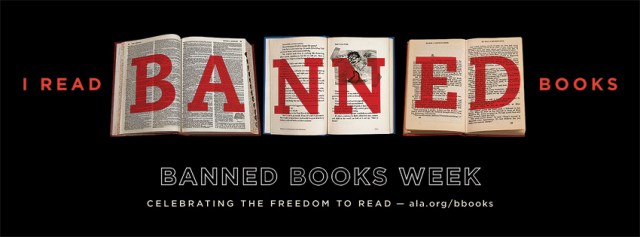
It’s national Banned Books Week, when bookstores and libraries put up their displays of frequently challenged or censored titles that various bluestockings have tried to keep from us over the years. Given the ever-declining reading habits of the country, it’s nice to see that some people out there still find the printed word (Adventures of Huckleberry Finn, Slaughterhouse-Five, Beloved, and so on) so threatening that they give it the perverse honor of trying to ban it.
This isn’t an issue of the past, school districts are still coming under fire for assigning certain books. In 2011, Sherman Alexie’s award-winning young adult novel The Absolutely True Diary of a Part-Time Indian was challenged for use in a ninth-grade Washington state class.
Just last year, the Tucson school district — in a fit of reactionary pique — decided to eliminate any books that offended their knuckle-dragging sensibilities. They removed any books that dealt with Mexican-American history; in a district where over half the students have some Mexican-American ancestry.
Not content with banning history, in January:
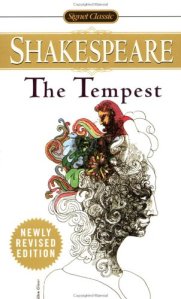
...administrators informed Mexican-American studies teachers to stay away from any units where “race, ethnicity and oppression are central themes,” including the teaching of Shakespeare’s classic [The Tempest] in Mexican-American literature courses.
Once upon a time, Decline of the West-styled conservatives like Allan Bloom were lamenting that American education was ignoring the classics in favor of a multiculturalist agenda. Now the very people who once might have once sided with Bloom are going after Shakespeare.
If you go here, you can find out how to submit your very own Virtual Read-Out video.
Depressing, provocative, or just plain true, here’s something to consider from Bryan Goldberg; he made millions off co-founding the incredibly popular crowd-sourced sports site Bleacher Report and is now trying to do the same for women-centered writing (whatever that is) at a site called Bustle. According to Goldberg:
Men, to the best of my knowledge, don’t even read … When’s the last time you heard a man say, ‘I’ve been reading this great book, you’d really like it’? My girlfriend always tells me about these books she’s reading, and I don’t even see her reading the book! Where does this book live?
Apparently it doesn’t occur to Goldberg to just pick up a book and find out what this fascinating and mysterious hobby is all about.
But in any case, he is not wrong in the aggregate, as any bookstore employee can tell you: Women buy books, men don’t. There is the occasional squawk of disagreement on this issue and plenty of anecdotal evidence to the contrary, but mostly, the numbers bear it out.
A 2007 story from NPR reported that even among avid readers, the typical woman read nine books a year, compared to five for men. Men make up just 20 percent of fiction reader. It’s hard to believe that those numbers have changed much in the past six years.
Back in 2005, novelist Ian McEwan (Atonement, the amazing new Sweet Tooth) tried an experiment. He and his son went around a London park distributing books for free. The result?
Every young woman we approached – in central London practically everyone seems young – was eager and grateful to take a book. Some riffled through the pile murmuring, “Read that, read that, read that …” before making a choice. Others asked for two, or even three.
The guys were a different proposition. They frowned in suspicion, or distaste. When they were assured they would not have to part with their money, they still could not be persuaded. “Nah, nah. Not for me. Thanks mate, but no.” Only one sensitive male soul was tempted.
“Frowned in suspicion, or distaste.” And remember, this was before every man had a smart phone to obsessively check up on sports scores.
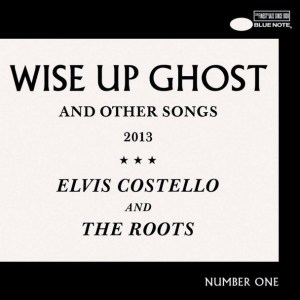
Apropos of nothing to do with music, it must be said that the cover for the new Elvis Costello and The Roots collaboration, Wise Up Ghost and Other Songs, is likely the album cover of the year. Clean with about being overly minimal, with an elegant serif typeface, it’s the sort of thing more bands should aspire to.
That remains true even if Elvis, Questlove and the boys are just paying homage to copying the cover for the classic City Lights edition of Allen Ginsberg’s first poetry collection Howl; a work that most likely had little direct influence on any of the artists working on this album.
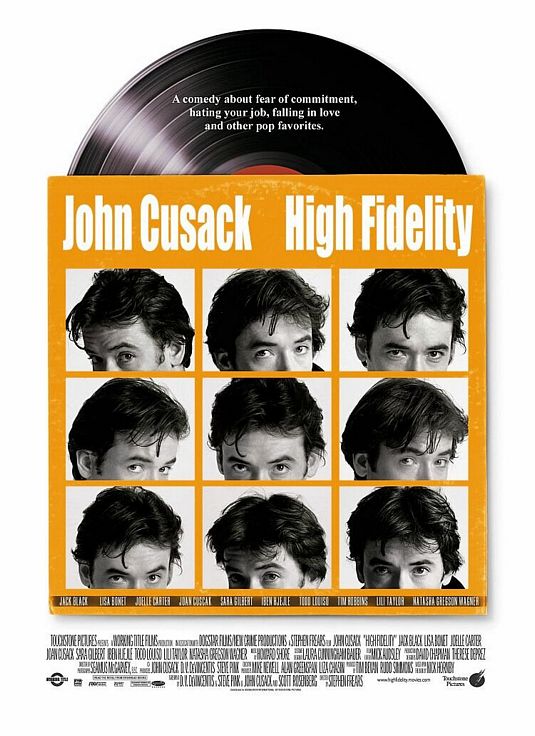
They’re here to make you feel bad about your choices: the record-store clerks of ‘High Fidelity’.
In the eternal classic High Fidelity, John Cusack plays Rob, a happily embittered record-store owner who spends a lot of time talking to the camera, when he’s not grousing about women, his employees, life. While his particular angle is music and the collecting rare examples thereof, many of his ruminations about that habit (“fetish properties are not unlike porn”) could apply equally to most any other art form. For instance:
What really matters is what you like, not what you are like… Books, records, films — these things matter. Call me shallow but it’s the fuckin’ truth.
Anybody out there who doesn’t believe deep down that there isn’t some truth to what he’s saying? Shallow or not, doesn’t bonding over the shared love of a particular cultural object (book, film, whatever) stand as its own unique and valid type of connection?
Here’s Rob on books:
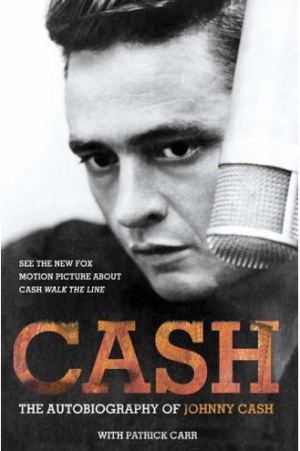
I’m not the smartest guy in the world, but I’m certainly not the dumbest. I mean, I’ve read books like The Unbearable Lightness of Being and Love in the Time of Cholera, and I think I’ve understood them. They’re about girls, right? Just kidding. But I have to say my all-time favorite book is Johnny Cash’s autobiography Cash by Johnny Cash.
Note the obsessive’s need to add the wholly unnecessary “Cash by Johnny Cash” there, just in case you didn’t get what he meant with “Johnny Cash’s autobiography.”
And here, just for kicks, the Top 5 Records scene from High Fidelity:

 Hoffman has played a few great figures from both sides of the literary page (Willy Loman, Truman Capote), but that’s not what gave him the credentials for this interview, it’s that he was clearly a passionate reader. Not a lot people out there these days who will stand up and shout for the dark glories of somebody like Richard Yates:






 Chris Barsanti
You must be logged in to post a comment.