
The 11-day Twin Cities Film Festival opens tomorrow, with over 120 features and shorts, including some high-profile award contenders and some cool documentaries, hitting theaters later this year.

The 11-day Twin Cities Film Festival opens tomorrow, with over 120 features and shorts, including some high-profile award contenders and some cool documentaries, hitting theaters later this year.

The newest family comedy from Tamara Jenkins (Slums of Beverly Hills, The Savages) follows a literary New York couple in the middle of a years-long saga to get pregnant. The results are often funny, but not pretty.
Private Life opened at the New York Film Festival and is now on Netflix and in some theaters. My review is at The Playlist:
Does it matter that Tamara Jenkins’ newest movie, “Private Life,” is only getting one of those mini boutique theatrical releases at the same time being released somewhere into the unknown algorithm wilds of Netflix for the whole nation to see?…
The trailer is here:

Novelist and poet Russell Banks (Family Life, Continental Drift, Affliction) had some advice for high school students in upstate New York a few years back:
Imagine the teller but also imagine the listener. What is fiction after all but a sort of visual hallucination — you’re asking the reader to see things that aren’t there.
When you’re writing, you’re taking a journey with words. Remember that you want the reader to come along with you.

James Dickey won a National Book Award for his poetry collection Buckdancer’s Choice. That was years before he hit the big time with Deliverance. To some degree, poetry remained his first and last love.
Later, in the 1985 collection How to Use the Power of the Printed Word, he offered some advice for aspiring, or even veteran poets. It begins with simplicity:
As for me, I like the sun, the source of all living things, and on certain days very good-feeling, too. ‘Start with the sun,’ D. H. Lawrence said, ‘and everything will slowly, slowly happen.’ Good advice. And a lot will happen…
Start by writing what’s in front of you. If you can capture that, it’s an amazing start.
(h/t: Maria Popova)

A hybrid superhero-antihero misfire that wastes Tom Hardy in a should-have-been great role, Venom is somehow even less fun than when he played both Kray twins a few years back in the London gangster epic bomb Legend.
Venom is playing now pretty much everywhere. My review is at Film Journal International:
There are plenty of characters from the Spider-Man universe who could manage having a movie all to themselves. Eddie Redmayne as the Green Goblin. Maybe Tilda Swinton as a gender-reversed Doctor Octopus; just imagine the goggles. In theory, Venom should be perfectly able to handle a story all on his own. Despite serving as a somewhat weak anti-Peter Parker in the mostly forgotten Spider-Man 3, the ravening parasitic alien being seems like a perfectly good villain to set loose on an unsuspecting world…

My review of the new Gary Shteyngart novel is at PopMatters:
One gets the sense from the start of Gary Shteyngart’s Lake Success that this is going to be something of a status report on the nation. And it’s not just because of Trump. Barry Cohen, the doofus we’re stuck with throughout, stumbles into Port Authority bleeding from his head and trying to get a ticket out of town. A fund manager with $2.4 billion in assets wearing a Citi-branded Patagonia vest over his Vineyard Vines shirt, he’s not a bus station type but nevertheless is feeling like he needs to go off the grid. No NetJet from Teterboro or Acela train for Barry…
One of the book’s chapters was excerpted at the New Yorker.

In Jeremy Saulnier’s bleak and bloody adaptation of William Giraldi’s bleak and bloody novel, a naturalist investigates the apparent killing of children by wolves in Alaska, only to encounter some far more dangerous creatures.
Hold the Dark is playing now in limited release and on Netflix. My review is at Film Journal International:
Jeffrey Wright never shows up to deliver good news. It would be nice if someday soon he gets to show up in a Judd Apatow movie. Suffice it to say that when Wright appears at a woman’s doorstep in Jeremy Saulnier’s gruesomely bleak Hold the Dark, it’s not to deliver a check from Publishers Clearing House…
Here’s the trailer:

When Vivian Gornick wanted a job at the Village Voice in the late 1960s, she wrote an article and sent it to them. Editor Dan Wolf then called her up and asked, “Who the hell are you?” She replied, “I don’t know, you tell me.” She got anxious, sent him another article every year or so, and only then asked for a job.
Gornick told Artforum what happened next:
‘[Wolf said] You write one piece a year, how can I give you a job?’ I said, ‘No more, I’ll do anything you ask.’ He said, ‘Spend a day at the Catholic Worker and write a piece about Dorothy Day.’ I did. Then Jack Kerouac died and Wolf said, ‘Go to Lowell, Mass., and report on the funeral.’ I did. One more assignment—and he gave me the job. And that is how I became a writer.
Fight your anxiety.
Keep on pushing.
When the editor tells you to go cover something or somebody, you go and do it.
And that is how you will become a writer.

My review of the Criterion Blu-ray edition of The Virgin Spring is at PopMatters:
You can easily imagine the characters in Ingmar Bergman’s devastating The Virgin Spring (Jungfrukällan, 1961) calling where they live “God’s country”. Their farm is situated in a kind of pristine wonderland of thick pine forests and gurgling streams. Religion plays a central role in most of their lives as well, with the mother, Mareta (Birgitta Valberg), seeming to spend her every waking moment in contemplation of God, and her husband, Tore (Max von Sydow), only slightly less fervent in his faith. They are certain of their place in the world, and God’s gifts to them…
Here’s a clip:

There’s a new Criterion Blu-ray edition out with a gorgeous presentation of Michael Powell and Emeric Pressburger’s 1946 wartime afterlife romance A Matter of Life and Death. And yes, it’s pretty much required viewing.
After making a run of cheery but subversive movies during World War II, always under the watchful eye of Winston Churchill — who refused to shut down the film industry as it was during the Great War — the Ministry of War came to [Powell and Pressburger] with a request: Could they make a movie that would make the British and Americans love each other? A seemingly odd request, given that the nations were at the time fighting tooth and nail to dislodge the Nazis from Western Europe…
Here’s a trailer:

In 1980, Roald Dahl was one of the world’s most famous authors. But when a young Jay Williams wrote a letter to Dahl asking for some writing advice, the author of James and the Giant Peach and The Witches, among other classics, took the time to write back.
Here’s part of what Dahl said:
I have read your story. I don’t think it’s bad, but you must stop using too many adjectives. Study Hemingway, particularly his early work and learn how to write short sentences and how to eschew all those beastly adjectives. Surely it is better to say “She was a tall girl with a bosom” than “She was a tall girl with a shapely, prominent bosom”, or some such rubbish. The first one says it all…
You can see the original letter here.
The young Williams grew up to become a newspaper writer, a job that obviously requires trimming the fat. Williams later said that Dahl’s response was the best advice he’d ever been given.

Novelist and all-around brilliant prose crafter Hilary Mantel has great advice for writers, here’s a few tastes:
- Are you serious about this? Then get an accountant.
- Write a book you’d like to read. If you wouldn’t read it, why would anybody else? Don’t write for a perceived audience or market. It may well have vanished by the time your book’s ready.
- Be aware that anything that appears before “Chapter One” may be skipped. Don’t put your vital clue there.
Anybody who wrote both Wolf Hall and Bring Up the Bodies should be listened to.

In the latest movie from Mexican director Alonso Ruizpalacios, Gael Garcia Bernal plays Juan, a slacker in 1980s Mexico who comes up with a spectacularly bad idea: to rip off antiques from the National Museum of Anthropology.
A heist comedy with melancholy and bite, Museo is playing now. My review is at Film Journal International:
Juan is a layabout sluggard wasting his days in the staid 1980s confines of Satellite City while occasionally attending veterinary school w. Ruizpalacios loops his movie around a few times before getting to the crux of the matter, rhythmically tracking life with a grinning world-weariness evoking the artfully composed New Wave ironies of his last feature, Güeros. When it becomes clear that Juan wants to rob the museum when it’s closed for renovations over the holidays, the movie doesn’t spend too much time on the machinations because the end result is obvious…
Here’s the trailer:

In the second season of Netflix’s Missouri noir Ozark, the Byrd family finds themselves being mired ever deeper in a cycle of moral compromise.
My review is at The Playlist:
Like almost every other show on Netflix, “Ozark” follows the “If Only BBC” rule. (Meaning things would have been a lot snappier if they’d lopped off two, three, even four episodes. Unless we’re talking about the new seasons of “Arrested Development,” in which case full cancellation is the only answer.) The first season started off with a hell of a setup. Early episodes were packed with grit and speed like some godsend of modern noir. Season 1 soon lost its way, not sure just how Southern Midwest gothic it wanted to go. That same schizoid attitude, a little from here and a little from there, prevails in Season 2…
Here’s the trailer:
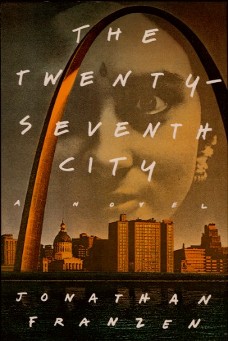
When he was starting out as a writer, Jonathan Franzen of St. Louis, Missouri (well, Webster Groves if we’re trying to be exact) figured New York was the kind of place that would demoralize and just eat him up. So he went to Somerville, Massachusetts, got an apartment for $300, and worked part-time. That’s when he wrote his first novel, The Twenty-Seventh City.
So now here’s what Franzen tells new writers:
Go to, like, northeastern Ohio, and write your first book. Go someplace cheap, and move to New York later.
Rent matters.
You must be logged in to post a comment.